For generations, mining has been defined by physical strength, heavy machinery and demanding work in remote and underground environments. That image has influenced not only how mining is perceived, but also who is encouraged to pursue a career in the sector. Yet the industry is changing. Automation, artificial intelligence, remote operations, robotics and data analytics are creating a new mining environment in which technical expertise and digital skills are becoming just as important as physical strength. For women, this transformation could open doors to roles that were once difficult to access.
As Alex Atkins, a Mining and Geotechnical Engineer and Non-Executive Director, observed: “Digital transformation is going to enable the greater inclusion of women and to give them more choice over how they can keep working in the industry once they have families.”
Her observation points to a much bigger shift. The question is no longer whether women can work in mining. They already do. The more important question is whether technology will help create a mining workforce where women can participate more fully, move into technical and operational positions, rise into leadership and build long-term careers.
Women currently account for roughly 10–15% of the large-scale mining workforce globally, although representation varies significantly between countries. Women also remain concentrated in administrative, human resources, finance, environmental and support functions, while their numbers often fall sharply in technical, trades, operational and underground roles.
Technology could change that equation.
A Different Kind of Mine
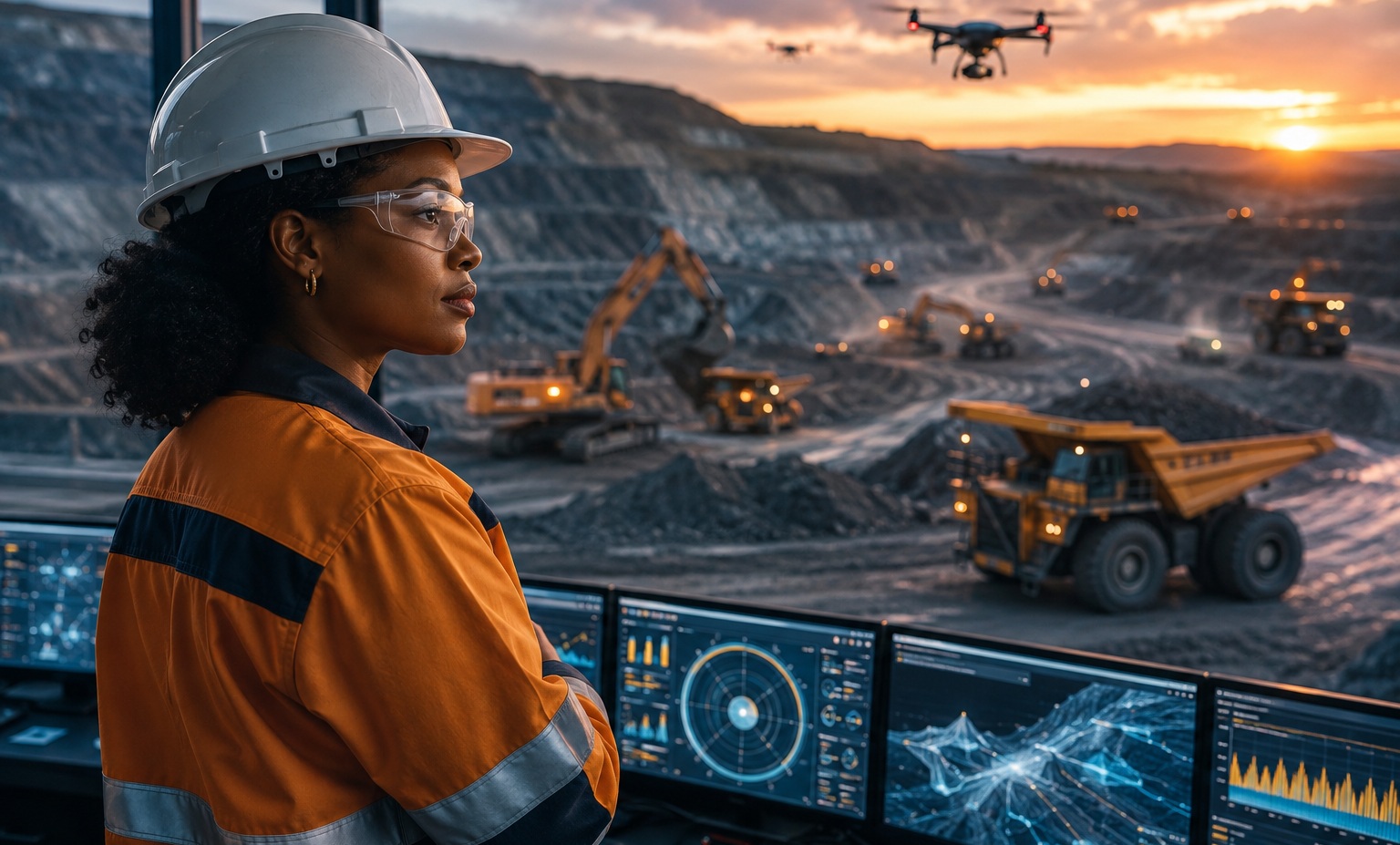
Walk into a modern mining operation and the picture is increasingly different from the traditional image of mining. Autonomous trucks can move materials with limited direct human intervention. Drones can survey large areas, sensors can monitor equipment continuously, and artificial intelligence can analyse complex operational and geological data.
This is changing the skills mining companies need. The industry increasingly requires data analysts, automation engineers, robotics specialists, cybersecurity professionals, digital geologists and control-room operators.
These jobs still require expertise, discipline and technical competence, but they are less dependent on physical strength. That matters because physical demands, workplace infrastructure and traditional perceptions about mining have historically contributed to women’s limited participation in core operational roles.
Technology does not automatically create equality, however. Women must be prepared for the opportunities it creates.
Chile Shows What Is Possible
Chile provides an encouraging example. Female participation in large-scale mining increased from approximately 7.7% in 2014 to about 24% in 2025, according to recent industry reporting.
That increase reflects changes in recruitment, training, workplace practices and the growing use of automation and digital technologies. As mining becomes more technologically sophisticated, women are gaining greater access to operational and technical positions traditionally dominated by men.
Chile’s experience offers an important lesson for other mining jurisdictions, including African countries: representation does not change simply because opportunities exist. Women must be deliberately prepared and given access to them.
Beyond Recruitment
It is tempting to measure women’s progress by asking how many women a mining company employs. But that number tells only part of the story.
The more important questions are: How many women are working in operations? How many are engineers? How many operate new technologies? How many are being promoted into management? How many are helping design the systems that will run tomorrow’s mines?
Some companies are already demonstrating what is possible.
BHP reported that women represented 41.3% of its global employee workforce by June 2025, compared with 17.6% in 2016. Women also represented 36.5% of people leaders and 41.3% of senior executives.
Hindustan Zinc has reported women representing more than 26% of its workforce, including women working in underground mining, digital control rooms, remote operations and mine rescue teams.
These examples challenge the old assumption that women belong mainly in the office while men operate the mine. The smarter mine needs women in both places.
Africa Cannot Miss the Opportunity
The transformation is particularly important for Africa, where mining remains central to many economies and demand for critical minerals is increasing.
Copper, lithium, cobalt, nickel and other minerals are becoming increasingly important to the global energy transition. As demand grows, mining companies will need to become more productive and technologically advanced while attracting skilled talent.
Women represent an enormous but underused resource.
The World Bank estimates that women account for around one-third of the global artisanal and small-scale mining workforce, although many remain concentrated in lower-paid and less protected activities.
Digitalisation could help change this. Digital training, financial technology, market information and safer technologies can give women greater opportunities to participate in mining value chains.
For Africa, the goal should therefore not simply be to bring more women into existing mining jobs. It should be to prepare women for the new mining economy being created by technology.
The Pipeline Must Start Early
If mining companies want more women in artificial intelligence, automation, engineering and digital operations, the pipeline must begin long before recruitment.
Companies can partner with universities and technical institutions to encourage girls and young women to study engineering, geology, computer science, mathematics, robotics and environmental sciences. Scholarships, internships, apprenticeships and mentorship can help turn education into careers.
Women already working in mining also need opportunities to reskill. An experienced engineer should be able to develop expertise in autonomous systems. A geologist should be able to work with advanced modelling and AI. A technician should have a pathway into digital operations.
The digital mine should create pathways upward rather than simply replace old jobs with new ones.
Building an Inclusive Mine
Technology may reduce some physical barriers, but women will not remain in mining if workplace cultures fail to evolve. Companies must address appropriate protective equipment, facilities, safety, harassment, shift structures, childcare challenges and promotion practices.
This is not simply about making mining more comfortable for women. It is about retaining the talent the industry needs.
Call to Action
For mining companies, governments and educational institutions, the question should no longer be, “How do we get more women into mining?”
It should be: “How do we prepare more women to build, operate and lead the mine of the future?”
That requires investment in STEM education, digital skills, technical training, mentorship and leadership development, alongside workplaces where women can progress.
Conclusion
The mine of tomorrow will be more automated, connected and dependent on people who can work confidently with technology. The industry can allow digital transformation to reproduce old gender inequalities, or it can use technology to open mining to a broader range of talent.
For women, the opportunity is not simply to enter mining.
It is to help redefine what mining becomes.
The smartest mine will not necessarily be the one with the most technology. It will be the one that combines advanced technology with the widest range of human talent and gives women an equal opportunity to help lead what comes next.




Comments are closed.