

By Blossom Ukoha
In Seoul, the future of technology is being built in places that look very different from one another: inside a global internet platform, a messaging ecosystem used by millions, an AI research laboratory, a venture capital firm backing AI native startups, a university lab working on explainable artificial intelligence, and the software division of one of the world’s largest automakers.
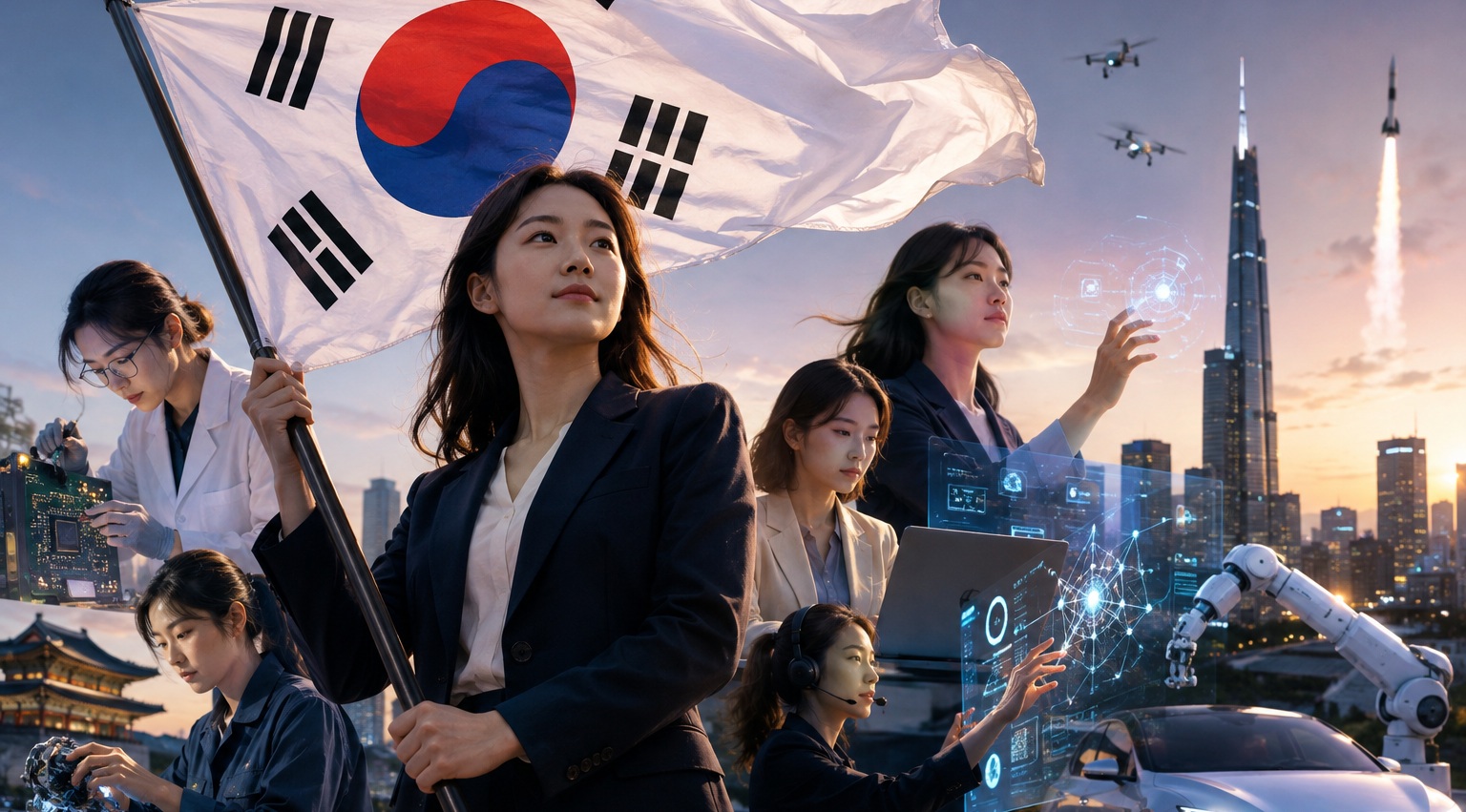
What connects these spaces is increasingly the presence of women shaping what comes next.
South Korea is already a global technology powerhouse, known for semiconductors, electronics, automobiles, telecommunications and increasingly artificial intelligence. Yet women remain underrepresented at the highest levels of the technology economy. Against that backdrop, a group of Korean women are occupying influential positions across platforms, AI research, digital transformation, entrepreneurship and investment.
Their stories demonstrate that technology leadership is no longer confined to engineering laboratories or semiconductor factories. It increasingly encompasses the platforms people use every day, the models that power AI, the infrastructure behind digital economies and the investment decisions determining which technologies scale.
Here are ten women helping shape that future.
Choi Soo Yeon: Leading Naver Into the AI Era
As CEO of Naver, South Korea’s dominant internet company, Choi Soo yeon sits at one of the country’s most important technology crossroads.
Appointed CEO in 2022, she became Naver’s second female chief executive and its youngest non-founder CEO. Her leadership has increasingly centred on artificial intelligence, with Naver integrating AI across search, advertising, commerce and other core services. Fortune ranked her among Asia’s most powerful women in 2025 and among the world’s most powerful women in 2026.
Under her leadership, Naver has also pursued what it calls sovereign AI: developing AI systems that reflect local languages, data environments and cultural contexts rather than relying exclusively on models developed elsewhere.
The strategy has become increasingly consequential as South Korea seeks greater technological independence in the global AI race. In 2026, Naver was expanding its AI infrastructure while continuing to integrate AI into its advertising and commerce businesses.
Choi therefore represents a new type of technology executive: one responsible not only for a digital platform, but for deciding how an entire national technology ecosystem participates in the AI economy.
Jung Shin a: Bringing AI Into Korea’s Everyday Digital Life
Jung Shin-a, CEO of Kakao, leads another of South Korea’s most influential digital platforms.
Kakao’s ecosystem extends far beyond messaging. Its services reach into mobility, payments, content and other aspects of everyday digital life, with KakaoTalk at the centre.
Her leadership has increasingly focused on bringing AI into that ecosystem. Fortune’s 2025 Asia ranking placed Jung at No. 24, highlighting her efforts to combine Kakao’s services with AI, including through its collaboration with OpenAI.
The importance of that strategy lies in distribution. AI becomes considerably more powerful commercially when it is integrated into platforms people already use.
Jung is therefore helping determine not only what AI can do, but how millions of consumers may encounter it in everyday life.
Han Seong-sook: From Naver Pioneer to National Technology Policy
Han Seong-sook represents the connection between corporate technology leadership and national economic policy.
She became Naver’s first female CEO in 2017 and led the company until 2022, helping expand its businesses across content, commerce and digital services. Before entering government, she had already established herself as one of South Korea’s leading technology executives. Yonhap notes that Fortune named her among its 50 Most Powerful Women in the World from 2017 to 2020.
Her influence subsequently moved into government. She served as Minister of SMEs and Startups from 2025 to 2026, where she worked on policies supporting entrepreneurs and small businesses.
In June 2026, President Lee Jae-myung nominated her as prime minister, and she subsequently became South Korea’s 50th prime minister on July 1, according to the official Prime Minister’s Office.
Her career is significant because it demonstrates how technology expertise can move from the boardroom into national policy. As South Korea competes in AI, semiconductors, and advanced industries, leaders who understand both technology companies and public policy become increasingly important.
Yejin Choi: Challenging the Idea That Bigger AI Is Always Better
Not all technology leadership happens inside corporations.
Yejin Choi, a South Korean-born computer scientist and Stanford researcher, has become one of the most influential voices challenging conventional assumptions about artificial intelligence.
A leading researcher in natural language processing and common sense reasoning, Choi was named to TIME’s 100 Most Influential People in AI in 2025. She is also a former MacArthur Fellow.
Her current research has increasingly focused on human-centered AI and the possibilities of smaller, more efficient language models. She has argued that the race toward ever larger models can overlook questions of efficiency, accessibility and who ultimately controls powerful AI systems.
Her contribution is therefore about more than making AI more capable. It is about asking what kind of AI society should build.
Joanne Jang: Shaping How Humans Interact With AI
Joanne Jang became internationally recognised for her work at OpenAI, where she served as Head of Model Behavior and was named to TIME’s 100 Most Influential People in AI in 2025.
Her work helped shape how AI systems behave, communicate and respond to users. That placed her at the intersection of technology, product design, policy and human-computer interaction.
Jang later transitioned from leading model behavior to a new role within OpenAI Labs focused on developing new interfaces for human-AI interaction. Her personal website currently describes her as leading OpenAI Labs, a research team exploring new interfaces between people and AI.
Her trajectory illustrates an increasingly important reality: the future of AI will not be determined only by model performance. It will also depend on how naturally, safely and meaningfully people interact with intelligent systems.
Songyee Yoon: Investing in the AI Native Generation
Songyee Yoon brings another dimension to technology leadership: capital.
The founder and managing partner of Principal Venture Partners, Yoon invests in early stage AI native companies. She previously served as president and chief strategy officer of South Korean gaming giant NCSoft and has a PhD in computational neuroscience from MIT.
In 2024, she launched Principal Venture Partners with an inaugural 100 million dollar fund focused on AI native startups.
Her significance lies in the bridge she represents between research, industry and investment. Before becoming a venture investor, she had already worked at the intersection of technology and entertainment and helped establish AI and natural language processing initiatives at NCSoft.
Now she is helping decide which emerging AI companies receive the capital and strategic support required to become major technology businesses.
Jin Eun Sook: Taking Digital Transformation Into Mobility
When Hyundai Motor Group promoted Jin Eun-sook to president effective January 2026, she became the group’s first female president at that level.
Her background is deeply rooted in technology. Before joining Hyundai in 2022, Jin served as chief technology officer at NHN. At Hyundai, she led ICT initiatives including the integration of the group’s global applications and the development of next-generation enterprise resource planning systems.
Her appointment is particularly significant because automobiles are rapidly becoming software-defined products.
Connected vehicles, cloud systems, data platforms, artificial intelligence and autonomous driving technologies are changing what it means to build a car. Jin’s leadership therefore places her at the intersection of traditional manufacturing and the software economy.
Hyundai has explicitly linked her promotion to its broader digital transformation and technology strategy.
Kim Ji-hyun: Building AI That Understands More Than Text
Kim Ji-hyun, CEO of Korea Deep Learning, represents South Korea’s emerging deep tech startup generation.
Her company develops AI technologies that combine computer vision, language models and document understanding. In 2026, Korea Deep Learning attracted attention for OCR technology designed to understand document layouts and context rather than merely recognise individual characters.
The company has also developed AI agent applications for sectors including finance, logistics and public administration.
Kim’s work demonstrates how AI innovation is increasingly moving from general-purpose models into specialised systems designed to solve specific industrial problems.
That transition from impressive demonstrations to useful infrastructure could become one of the most important stages of the AI economy.
Kim Seul ah: Turning Logistics Into Technology
Kim Seul ah, founder and CEO of Kurly, demonstrates that technology entrepreneurship does not always have to look like an AI laboratory.
Kurly transformed grocery shopping in South Korea through technology-enabled commerce and its signature early morning delivery model. Kim founded the company after previous experience in finance and consulting, building it into one of Korea’s best-known technology-enabled commerce businesses.
The company’s technology extends across logistics, inventory management, fulfilment and customer experience.
Her story matters because digital transformation often happens behind the scenes. Consumers may see an app and a delivery service, but underneath is a complex technological infrastructure connecting warehouses, suppliers, logistics networks and customers.
Kim’s leadership shows how women entrepreneurs can build technology businesses even when technology is not necessarily the product customers see first.
Su In Lee: Making AI More Explainable
Su In Lee, Professor of Computer Science and Engineering at the University of Washington, represents the research frontier.
Her work focuses on machine learning, computational biology and clinical informatics, including developing interpretable machine learning methods that can help researchers and clinicians understand how AI reaches its conclusions.
In 2024, she became the first woman to receive the Samsung Ho Am Engineering Award, a major recognition of her research.
Her research has become even more relevant as AI moves into healthcare and other areas where decisions can have serious consequences. In 2026, Lee continued to advocate for explainable AI as a bridge between human expertise and increasingly sophisticated machine learning systems.
Her message is particularly important for the next phase of AI: powerful systems must also become systems that people can understand, question and trust.
A Technology Story That Is Bigger Than Representation
These women do not represent a single version of technology leadership.
Choi Soo-yeon is transforming a national internet giant through AI. Jung Shin-a is integrating AI into one of Asia’s most influential digital ecosystems. Han Seongsook has carried technology leadership into national policy. Yejin Choi is challenging assumptions about how AI should be built. Joanne Jang has worked on how humans interact with intelligent systems. Songyee Yoon is directing capital towards AI native companies. Jin Eun Sook is helping turn a global automaker into a more software driven organisation. Kim Ji-hyun is building specialised AI systems. Kim Seul Ah has transformed commerce through technology and logistics. Su In Lee is pushing AI toward greater interpretability.
Together, they reveal something important about South Korea’s technology future.
The country’s next technological chapter will not be written only in semiconductor fabs or engineering laboratories. It will also be written by women leading platforms, directing capital, building startups, shaping public policy and asking the difficult questions about what technology should become.
For a country whose global influence has been built on technological ambition, the growing visibility of women across that ecosystem is more than a representation story. It is part of the country’s innovation story itself.





Comments are closed.