

By Blossom Ukoha
What if the most important stories about Kenyan women are not the ones making tomorrow morning’s headlines?
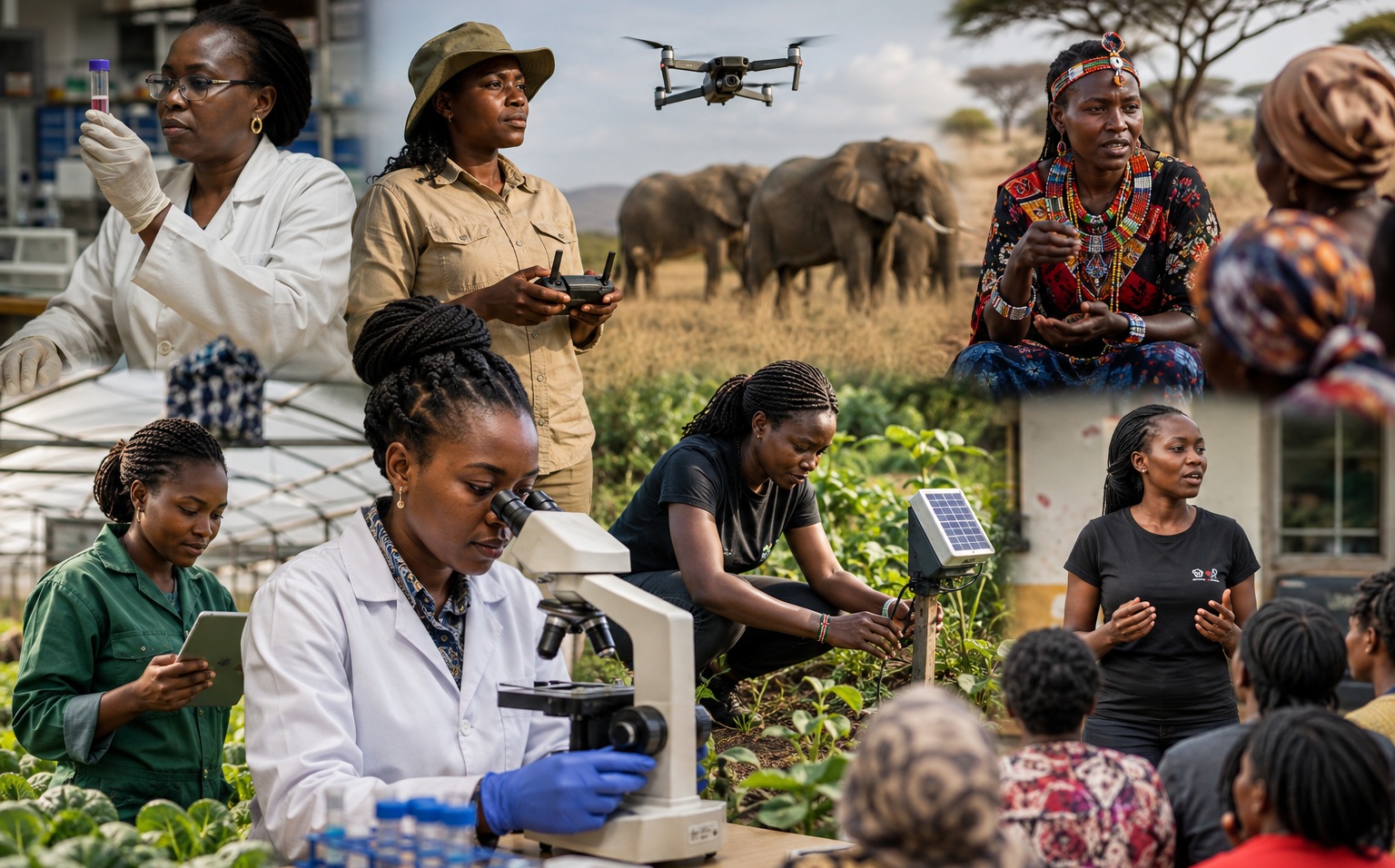
Open a Kenyan newspaper and the familiar names are easy to find: politicians, business leaders, celebrities and the personalities at the centre of the latest national controversy. But beyond the political drama and celebrity spotlight, thousands of Kenyan women are doing work that may never become front-page news—developing health research, protecting wildlife, responding to climate change, building technology, advancing disability inclusion and strengthening communities.
Their influence is often quiet, but its consequences are not.
From laboratories and farms to classrooms, rangelands and policy rooms, these women are helping solve some of Kenya’s most difficult problems. They may not dominate the headlines, but they are helping shape the country Kenya will become.
Women Changing the Conversation Around Science
At the KEMRI-Wellcome Trust Research Programme in Kilifi, Prof. Dorcas Kamuya has built her work around a question that is increasingly important in African research: who benefits from scientific knowledge?
Through her work in health systems and research ethics, Kamuya focuses on issues including community rights, data ownership and the responsibilities of researchers towards the communities involved in their work. It is a less glamorous side of science, but an essential one. Research can change lives, and the question of how it is conducted matters almost as much as the discoveries themselves.
Then there is Linah Akinyi Ochieng, a young scientist from Siaya whose work in immunology earned recognition and a scholarship for doctoral study at the University of Oxford’s Kennedy Institute. Her research into inflammatory diseases represents the growing contribution of African scientists to global health research.
Across Kenya, other researchers, including Dr. Benta Abuya, Dr. Lucy Wakiaga and Dr. Lydia Namatende-Sakwa, are contributing to conversations around education, gender equity, curriculum development and refugee teacher inclusion.
Their work rarely produces the drama of a political headline. Its impact, however, can last much longer.
The Women Protecting Kenya’s Environment
Climate change has transformed everyday life for millions of Kenyans, particularly communities dependent on agriculture, livestock and natural resources. Yet some of the women responding to these pressures remain almost invisible beyond their communities.
In Samburu, Florence Ntisai and members of the Kimunyak Differently Abled Initiative are challenging the exclusion of women with disabilities from climate decision-making.
Their message is simple but powerful: people living with disabilities should not be treated as passive recipients of climate assistance. They should have a voice in designing the policies that affect their lives.
Elsewhere, women are taking on roles traditionally dominated by men.
In the Kasigau Corridor, female members of Team Owl, including Ruth Katumbi Mathitu, Muna Kalutu and Jane Mwaingati, have trained as drone pilots for wildlife monitoring, anti-poaching operations and rapid response.
The image of women using technology to protect elephants and monitor one of Kenya’s important wildlife corridors challenges the old idea of what a conservationist looks like.
And conservation is not always about wildlife.
In Laikipia, the Iloplei Twala Cultural Manyatta Women’s Group has explored ways of turning invasive cactus into biofuel, while women across pastoralist communities are participating in tree planting, rangeland restoration and climate adaptation.
These are not abstract environmental campaigns. They are practical responses to changing landscapes and increasingly unpredictable livelihoods.
From Farms to Artificial Intelligence
Kenya’s reputation as a technology hub is often associated with Nairobi’s famous start-up ecosystem. But innovation is happening far beyond the capital.
Young women such as Faith Mosonik, Joan Nkatha and Melanie Minayo, associated with Jomo Kenyatta University of Agriculture and Technology, have gained recognition through international Huawei ICT competitions, demonstrating the growing presence of Kenyan women in computing and technology.
Other innovators are taking technology directly to the people who need it most.
Esther Wanjiru, through Farmer Lifeline Kenya, has worked with AI and solar-powered tools to help farmers identify crop pests and diseases. Such innovations may sound highly technical, but their purpose is remarkably practical: helping farmers detect problems earlier, reduce losses and make better decisions.
Other Kenyan women are working with plastic waste, climate-smart food products and traditional grains, demonstrating that innovation does not always mean building the next billion-dollar technology company. Sometimes it means finding a better answer to a problem that a community has faced for generations.
Women such as Maryanne Gichanga are also building climate-focused agricultural solutions informed by personal experience with drought and farming.
Their innovations sit at the intersection of technology, food security and climate resilience.
Leadership Without a Title
Some of Kenya’s most consequential women leaders do not have government positions or corporate corner offices.
They lead through mentorship, community organising and advocacy.
Fidelis Karanja, associated with the Young African Women Initiative, has focused on mentoring young women towards leadership in business, politics and institutions. Her work reflects a different kind of leadership—one measured not by the size of an organisation, but by the number of people who become more confident and capable because someone invested in them.
Across the country, women organisers are also active in anti-femicide campaigns, disability advocacy, youth movements and community development. Many coordinate fundraising, arrange medical assistance, provide legal support, organise demonstrations or help vulnerable families without ever becoming household names.
They are leaders because people trust them, not because they hold impressive titles.
Why Aren’t We Seeing More of Them?
The problem is not necessarily that Kenyan women are absent from public life. It is that the media does not always tell their stories with the same frequency or prominence given to politics, celebrity and crisis.
Women remain underrepresented in news coverage, particularly in areas such as politics, business and economics. When women do appear in the media, they can also be more likely to be presented through stories of victimhood or personal experience than as experts, decision-makers and innovators.
That creates a visibility gap.
A woman developing a climate solution over ten years may receive less attention than a politician involved in a controversy that lasts two days. A researcher quietly improving health systems may attract fewer headlines than a celebrity announcement. A woman organising a community against drought may never receive the attention given to a dramatic climate disaster.
Yet these women are building something more durable than a news cycle.
The Stories Worth Looking For
Kenya’s story of women’s leadership cannot be told only through the women who appear regularly on television or dominate newspaper covers.
It must also include the scientist asking difficult ethical questions in Kilifi, the young researcher preparing for a career in global health, the woman with a disability demanding a place at the climate-policy table, the female conservationist flying a drone over an elephant corridor, the farmer using artificial intelligence to protect her crops and the community organiser mentoring a girl who may one day lead a national institution.
Their work is rarely loud. But it is consequential.
Perhaps the challenge for Kenyan media and for audiences is to expand our definition of whose story is newsworthy. Because sometimes the women changing a country are not standing behind podiums or appearing on front pages.
They are in laboratories; they are on farms; They are in classrooms; they are in rangelands; they are in community meetings and policy rooms.
And while Kenya may not always see them on the front page, the future they are building is already being lived.





Comments are closed.