

By Candy Swiss
“A home should not only reflect where you are going; it should honour where you come from.”
Maya had just moved into her first apartment after years of building a successful career. Like many young professionals, she filled it with everything social media said a modern home should have: white walls, sleek furniture, polished surfaces and carefully curated décor. The space was beautiful, but every time she walked through the front door, something felt missing. It looked like a showroom rather than a home. It wasn’t until her grandmother gifted her a handwoven basket, an indigo Adire cushion and a carved wooden stool that the room began to tell her own story. Suddenly, the space no longer reflected someone else’s idea of luxury. It reflected hers.
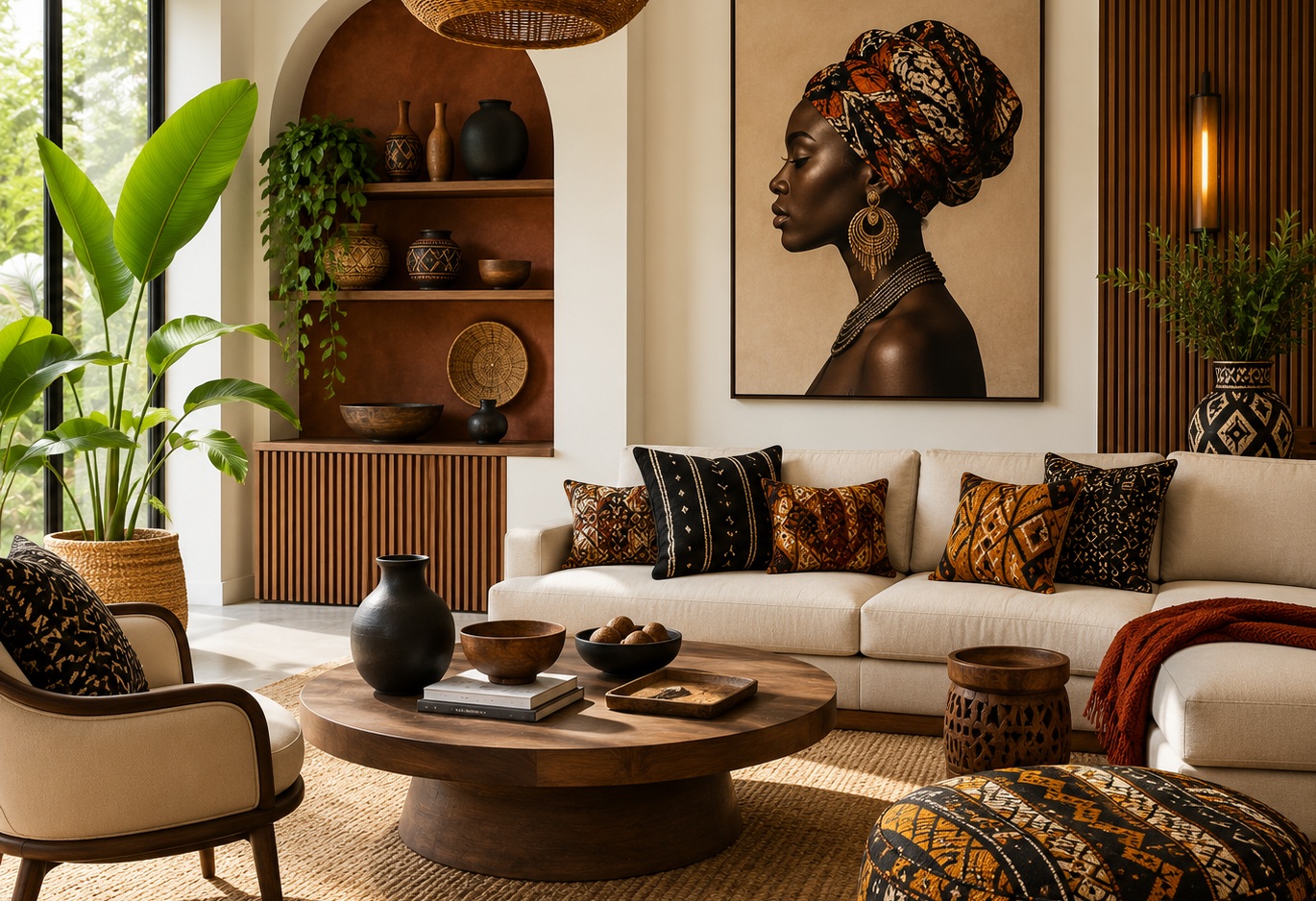
Across Africa and the diaspora, many women are discovering the same thing. While modern minimalism offers calm and simplicity, it can sometimes leave homes feeling cold and disconnected from the people who live in them. Increasingly, homeowners are embracing a more personal design language known as Afro-Minimalism, an emerging interior style that combines the clean lines and intentional simplicity of contemporary design with the warmth, craftsmanship and cultural richness of African heritage. The result is a home that feels sophisticated without losing its soul.
When Less Becomes More Meaningful
Unlike traditional Afrocentric interiors, which often celebrate bold colours and layered patterns, Afro-Minimalism takes a more restrained approach. Rather than filling every corner with décor, it allows a few carefully selected pieces to become the heroes of the space.
A single Adire cushion from Nigeria, a handwoven mudcloth throw from Mali, a carved wooden stool from Ghana or a beautifully crafted ceramic vase from South Africa can instantly transform an otherwise minimalist room. Every object has purpose, every material has texture and every piece carries a story.
It is this philosophy of intentional living that makes Afro-Minimalism so appealing to today’s professional woman. Her home becomes more than a stylish address. It becomes a reflection of her identity, her heritage and the life she is intentionally building.
A Design Movement Gaining Global Attention
Afro-Minimalism is no longer a niche aesthetic. It is becoming one of the most talked-about interior design movements across Africa and the global design community.
According to Pinterest Predicts, searches for “afrobohemian home décor” increased by approximately 220 percent, while searches for Adire fabric rose by about 130 percent heading into 2026. Although Afrobohemian interiors embrace more layers and eclectic styling, the data reflects a growing appreciation for African textiles, craftsmanship and heritage-inspired living.
Across Kenya, Nigeria, Ghana and South Africa, designers are moving away from the stark, all-white interiors that dominated global design for years. In their place are warm earth tones, tactile materials and handcrafted pieces that create homes with both elegance and emotional depth.
More Than Beautiful Spaces
The rise of Afro-Minimalism is also creating economic opportunities for African artisans and creative entrepreneurs.
Statista projected that the African home décor market would generate approximately US$4.12 billion in revenue by 2025, supported by increasing demand for handmade and locally sourced products. At the same time, the African textile market, valued at approximately US$39.21 billion in 2025, is forecast to reach almost US$49.41 billion by 2030.
Every purchase of a hand-dyed textile, woven basket or handcrafted wooden table does more than decorate a room. It supports local artisans, preserves traditional craftsmanship and strengthens Africa’s creative economy.
For many women entrepreneurs, Afro-Minimalism is becoming both a cultural movement and a business opportunity.
The Beauty of Natural Materials
One of the defining characteristics of Afro-Minimalism is its deep appreciation for materials that age gracefully.
Instead of glossy finishes and mass-produced accessories, the style celebrates clay, linen, timber, woven raffia, sisal, jute, stone and hand-carved wood. These materials introduce warmth, texture and authenticity while maintaining the clean aesthetic associated with minimalism.
The colour palette is equally timeless. Soft creams, terracotta, charcoal, ochre, olive green and warm browns create interiors that feel peaceful without becoming sterile. Natural light is welcomed, furniture is thoughtfully arranged and open spaces are valued just as much as decorative objects.
The result is an environment that encourages rest, reflection and meaningful living.
Women Redefining African Design
Some of Africa’s most respected creatives are helping shape this new design language.
Nigerian architect Tosin Oshinowo has become internationally recognised for creating calm, contemporary spaces that combine modern architecture with natural stone, timber and subtle African influences. Her work demonstrates that African design can be both globally sophisticated and deeply rooted in local identity.
Beyond architecture, Ghanaian fashion brand Ajabeng has embraced an Afro-Minimal philosophy by combining minimalist silhouettes with refined African textile traditions. Their work reflects a broader cultural movement in which heritage and modernity are no longer seen as opposites but as complementary expressions of contemporary African creativity.
Author Christine Platt, whose book The Afrominimalist’s Guide to Living With Less has inspired readers around the world, also challenges conventional ideas of minimalism. She argues that true minimalism should reflect people’s authentic lives rather than an aesthetic formula, encouraging individuals to create spaces that honour their culture, memories and personal stories.
Designing Homes That Tell Stories
Perhaps the greatest appeal of Afro-Minimalism is that it reminds us that our homes should tell our own stories.
A woven basket inherited from a grandmother. A handcrafted clay pot purchased during a trip to Ghana. An Adire cushion made by Nigerian artisans. These are not simply decorative objects. They become daily reminders of heritage, family and identity.
This intentional approach to decorating also aligns with the growing desire for sustainable living. Rather than constantly replacing trendy décor, Afro-Minimalism encourages investing in timeless, handcrafted pieces that become more meaningful with age.
A Home That Reflects Who You Are
For today’s woman, home is far more than a place to sleep. It is where ideas are born, families gather, businesses are built and personal wellbeing is restored.
Afro-Minimalism reminds us that elegance does not require excess. Sometimes, one beautifully woven textile, one handcrafted chair or one carefully chosen ceramic piece can say more than an entire room filled with furniture.
In a world increasingly driven by fast trends and mass production, this emerging design movement offers something refreshingly different. It invites women to create homes that are calm yet expressive, modern yet rooted, simple yet deeply meaningful.
Because the most beautiful interiors are not those that imitate someone else’s style. They are the ones that quietly tell the story of who we are and where we come from.





Comments are closed.