
By Blossom Ukoha
“Women are not only the victims of conflict, they are the architects of peace.” — Phumzile Mlambo-Ngcuka, Former Executive Director of UN Women
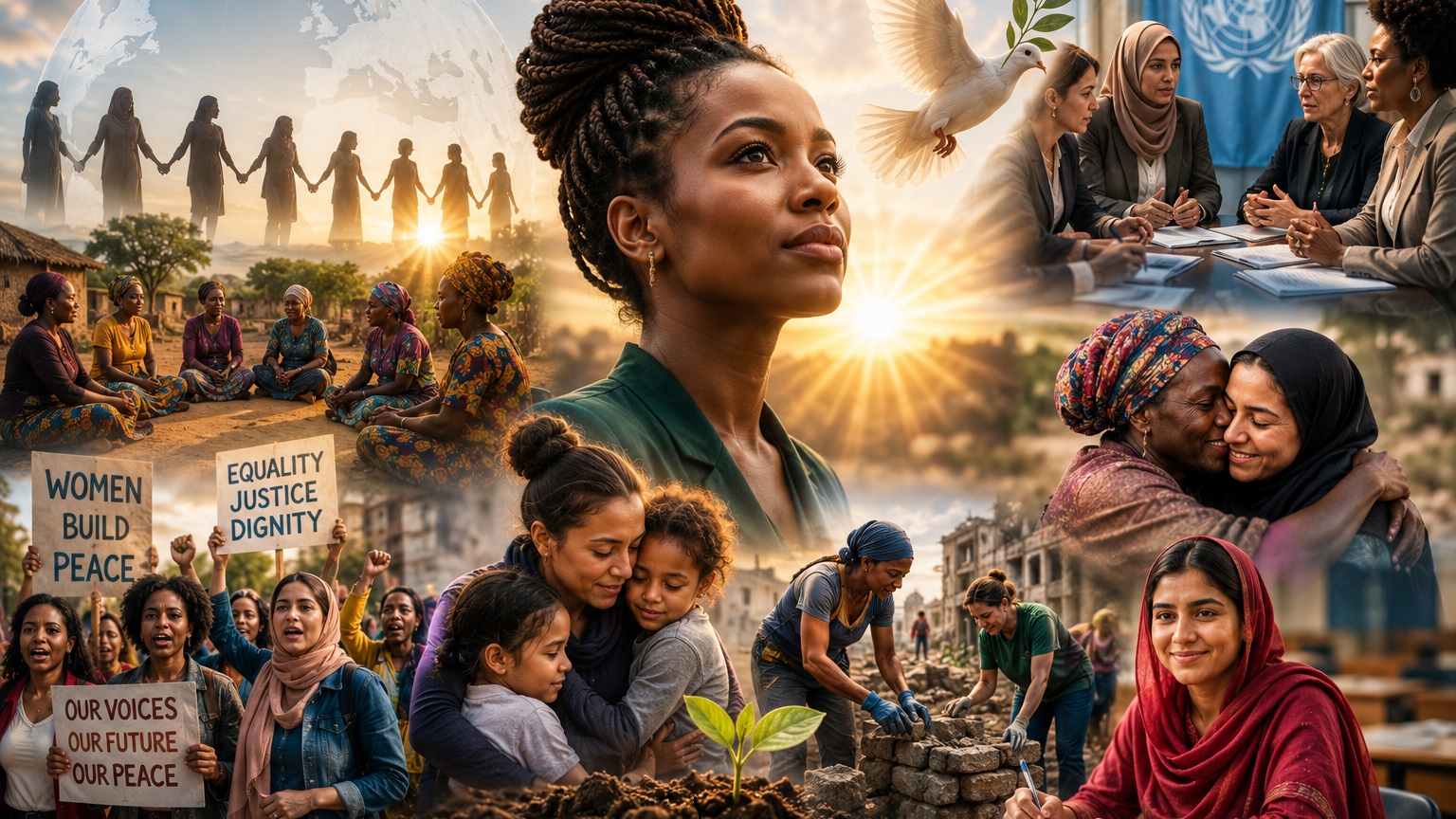
Phumzile Mlambo-Ngcuka, former Executive Director of UN Women, was not merely making an inspiring statement. She was reflecting a reality supported by decades of evidence. Across history, women have stood at the frontlines of peacebuilding, not with weapons but with courage, dialogue, resilience, and an unwavering commitment to rebuilding communities shattered by conflict. While wars are often remembered through the generals who fought them, peace is frequently sustained by the women who negotiated reconciliation, protected families, defended human rights, and refused to let violence define the future. Increasingly, global data and the stories of remarkable women leaders affirm what Mlambo-Ngcuka’s words suggest: if peace had a face, it would indeed look remarkably like that of a woman.
For centuries, women have been among the first to bear the consequences of conflict and the first to begin repairing its damage. They have sheltered displaced families, mediated local disputes, advocated for survivors of wartime sexual violence, rebuilt schools and healthcare systems, and championed justice long after the cameras have left. Yet despite playing these indispensable roles, women continue to be significantly underrepresented in the formal spaces where peace agreements are negotiated and political futures are decided.
The Evidence Is Impossible to Ignore
The evidence supporting women’s role in peacebuilding is both compelling and undeniable.
Although women remain at the forefront of grassroots peace efforts, they account for only 7–14% of negotiators, mediators, and signatories in major peace processes worldwide. Their exclusion from formal negotiations stands in sharp contrast to research showing that peace agreements are more likely to be reached and sustained when women participate meaningfully.
Beyond official negotiations, women lead countless community initiatives that rarely make international headlines. Across Africa, Asia, Latin America, and the Middle East, they organise dialogue forums, operate peace huts, mediate ethnic and religious disputes, prevent youth violence, and rebuild trust between divided communities. These everyday acts of diplomacy often determine whether fragile peace survives.
The Women, Peace and Security (WPS) agenda, established through United Nations Security Council Resolution 1325, has inspired more than 100 countries and territories to adopt National Action Plans that promote women’s participation in peace and security. Yet surveys consistently show that while women are highly influential within their communities, they continue to face significant barriers to leadership in national and international peace negotiations.
Women Who Became the Face of Peace
Peace has many heroes, but some women have become global symbols of what courageous, nonviolent leadership can achieve.
Leymah Gbowee: The Woman Who Ended a Civil War
When Liberia was consumed by one of Africa’s bloodiest civil wars, Leymah Gbowee united Christian and Muslim women in the Women of Liberia Mass Action for Peace. Through peaceful demonstrations, prayer campaigns, and relentless advocacy, they pressured political leaders to negotiate an end to the conflict, helping bring Liberia’s devastating civil war to a close in 2003.
Gbowee shared the 2011 Nobel Peace Prize and continues her work through the Gbowee Peace Foundation Africa, promoting education and leadership opportunities for girls and young women.
Ellen Johnson Sirleaf: Rebuilding a Nation
Peace does not end when guns fall silent. Liberia’s recovery required visionary leadership, and Ellen Johnson Sirleaf, Africa’s first democratically elected female president, provided exactly that. From 2006 to 2018, she rebuilt democratic institutions, strengthened governance, restored public confidence, and expanded opportunities for women.
Her role in advancing women’s participation in peacebuilding earned her a shared 2011 Nobel Peace Prize, recognising that lasting peace depends on building inclusive societies after conflict.
Tawakkol Karman and Malala Yousafzai
Known as the “Mother of the Yemeni Revolution,” Tawakkol Karman became one of the leading voices of Yemen’s 2011 pro-democracy movement. Through Women Journalists Without Chains, she championed freedom of expression, democracy, and human rights despite enormous personal risks, earning a share of the 2011 Nobel Peace Prize.
Similarly, Malala Yousafzai transformed personal tragedy into global advocacy after surviving a Taliban assassination attempt in 2012. As the youngest ever Nobel Peace Prize laureate, she continues to champion girls’ education through the Malala Fund, recognizing education as one of the strongest foundations for lasting peace.
Justice Is Also Peace
Peace is not merely the absence of war; it also requires justice, accountability, and the protection of fundamental rights.
Nadia Murad, a survivor of ISIS captivity and sexual slavery during the Yazidi genocide, has become one of the world’s strongest advocates against conflict-related sexual violence. Awarded the 2018 Nobel Peace Prize, she continues supporting survivors through Nadia’s Initiative.
Journalist Maria Ressa, recipient of the 2021 Nobel Peace Prize, has shown that defending truth is essential to preserving democracy and preventing conflict. Through investigative journalism, she has exposed disinformation, authoritarianism, and abuse of power while warning about the growing dangers of AI-driven misinformation.
Similarly, Iranian human rights defender Narges Mohammadi, awarded the 2023 Nobel Peace Prize while imprisoned, continues to symbolize resistance against oppression and the fight for women’s rights and human dignity. In Venezuela, opposition leader María Corina Machado, recipient of the 2025 Nobel Peace Prize, has become an international symbol of peaceful democratic resistance despite political persecution and exclusion from elections.
Recognition Still Falls Short
Despite these extraordinary achievements, women remain significantly underrepresented among the world’s highest peace honors.
Out of more than 110 individual Nobel Peace Prize laureates, only about 20 have been women, representing roughly 16–18% of recipients. While that number has increased over time, it also highlights how many women’s contributions remain overlooked.
Beyond Nobel laureates, influential peace advocates such as Mairead Maguire, Shirin Ebadi, Jody Williams, and Rigoberta Menchú Tum continue advancing nonviolence, human rights, transitional justice, Indigenous reconciliation, and humanitarian causes across the globe.
Peace Is Built in Communities
Some of history’s greatest peace breakthroughs never began inside presidential palaces.
Women played decisive roles in the Northern Ireland peace process, where Monica McWilliams and the Northern Ireland Women’s Coalition ensured education, victims’ rights, equality, and community reconciliation became central to the Good Friday Agreement negotiations.
Women have also served as influential mediators in peace efforts in the Philippines, Colombia, Yemen, Liberia, and Malawi, where they continue resolving disputes, discouraging child marriage, strengthening communities, and promoting social cohesion. These efforts rarely receive global headlines, yet they often determine whether violence returns or communities move forward together.
More Than a Symbol
To say that peace has the face of a woman is not to suggest that women are inherently more peaceful than men. Rather, it recognises a documented global pattern: women consistently expand the meaning of peace beyond ceasefires and political settlements. They advocate for education, justice, healthcare, economic opportunity, reconciliation, and human dignity, the very foundations upon which lasting peace depends.
As conflicts become increasingly complex, the world cannot afford to exclude women from decision-making. Their participation is not simply a matter of representation; it is a matter of effectiveness. The evidence is clear that societies benefit when women’s voices shape peace processes from negotiation to reconstruction.
If peace had a face, it would not be because women never experience conflict. It would be because, time and again, they have chosen to transform conflict into dialogue, pain into healing, and division into hope.
In a world desperately searching for lasting peace, perhaps the greatest lesson history offers is this: when women are empowered to lead, peace is not only possible; it becomes far more likely to endure.
A Call to Action
Peace is not built by governments alone. It is built in homes, classrooms, boardrooms, communities, and around negotiating tables where every voice matters. Governments, institutions, civil society organisations, and communities must move beyond recognising women’s contributions and intentionally create opportunities for women to lead peacebuilding efforts at every level.
When women are empowered to build peace, nations become stronger, communities become more resilient, and future generations inherit a world where dialogue triumphs over division. The face of peace is not merely a symbol. It is a call to action. Let us ensure that women are not only part of the conversation but are helping lead it.



Comments are closed.