By Blossom Ukoha
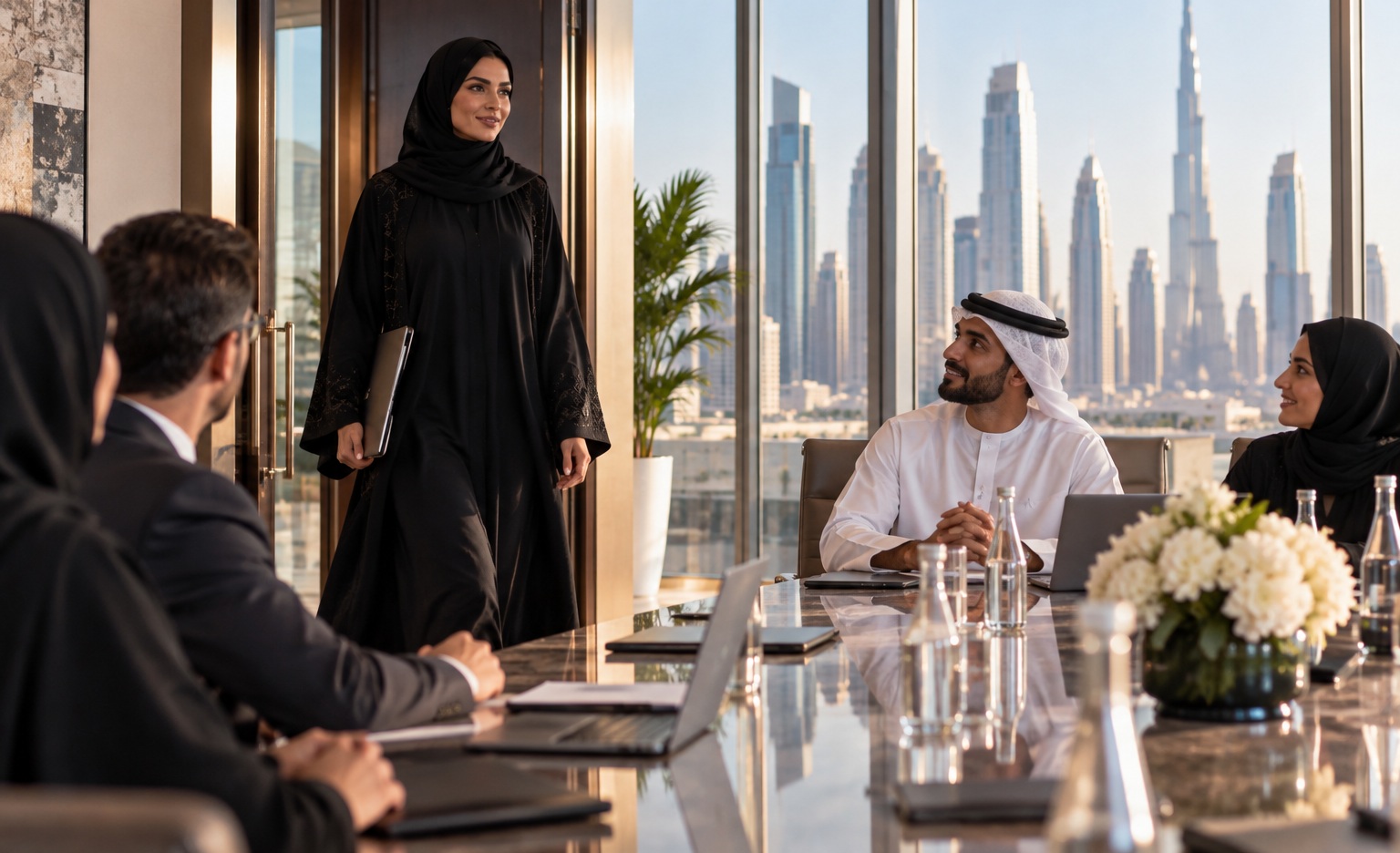
She is not there as a guest. She is not there to represent a family name or add diversity to a photograph. She is there because she owns the company, leads the strategy, sits on the board or has a decision to make.
Outside, Dubai continues to project its familiar image of glass towers, luxury brands and spectacular ambition. But behind that polished skyline, another story is taking shape, one in which Emirati women are increasingly becoming builders of businesses, leaders of institutions and participants in decisions that shape the UAE economy.
The numbers tell part of that story.
In March 2026, the UAE Ministry of Economy and Tourism reported that the country had 48,257 Emirati women entrepreneurs, while Emirati women owned or co-owned 114,050 SMEs across diverse economic sectors. The National SME Programme alone had attracted 2,700 Emirati women entrepreneurs.
These figures matter because entrepreneurship is not simply about starting a company. It is about moving from participation to ownership—from having a place in an economy to helping determine where that economy goes.
From Participation to Economic Influence
That shift is also visible in the private sector.
The UAE has spent years building an ecosystem around entrepreneurship, skills development and Emiratisation, creating pathways for Emirati talent to enter and progress within private enterprise.
The result is a growing pipeline of women entering skilled professions and leadership roles, particularly among younger generations.
But the more interesting question is not simply how many women are working.
It is where their work is taking them.
Are they becoming decision-makers? Are they controlling capital? Are they sitting at the tables where corporate strategies are determined? Are they building businesses capable of expanding beyond the UAE?
Increasingly, the answer is yes.
And nowhere is that shift more visible than in the boardroom.
The Boardroom Is Becoming Part of the Story
According to the GCC Board Gender Index 2026, women held 15 per cent of board seats at UAE-listed companies 191 of 1,274 positions as of January 2026. The figure has risen substantially from 3.5 per cent in 2020.
That does not mean parity has been reached. It does mean the composition of corporate decision-making is changing.
And the significance goes beyond representation.
A board seat is not simply a title. It places a woman closer to decisions about investment, risk, strategy, governance and long-term growth.
That distinction matters because economic influence is ultimately about more than being present in the workforce. It is about having a voice in what organisations build, fund and become.
A Business Ecosystem Built to Move Women Forward
The rise of Emirati women entrepreneurs is also connected to a broader national architecture.
The UAE’s National Programme for SMEs provides Emirati entrepreneurs with access to technical and administrative expertise, training, financing support, marketing channels and opportunities linked to government and semi-government procurement.
In January 2026, the Ministry of Economy and Tourism also announced agreements designed to expand contracting opportunities for Emirati SMEs, with seven government entities signing 55 contracts worth AED 78.6 million with Emirati small and medium-sized enterprises.
This is important because starting a business is only the beginning.
A thriving entrepreneurial ecosystem must help businesses survive, scale and reach markets.
The UAE’s wider environment is also significant. The Global Entrepreneurship Monitor’s 2025/2026 report ranked the UAE first globally in its National Entrepreneurship Context Index for the fifth consecutive year, assessing factors including government policy, finance, infrastructure and market access.
As GEM puts it, “Entrepreneurship is a system, not an accident.”
That principle helps explain why the women’s business story is becoming more visible.
The Next Chapter Is Bigger Than Fashion and Lifestyle
Dubai’s image has long been powerful enough to attract the world’s attention. But Emirati women’s economic story is increasingly extending beyond the sectors traditionally associated with the city.
Technology. Finance. Healthcare. Education. Sustainability. Creative industries. Professional services. Innovation.
The Ministry of Economy and Tourism has also highlighted efforts to expand Emirati SMEs onto global technology platforms, including the participation of 20 Emirati startups and SMEs at GITEX AI Europe 2026.
This is where the story becomes particularly significant.
The future of Dubai and the wider UAE economy will not be defined only by the ability to attract international capital, tourists and global companies. It will also depend on the ability to develop home-grown businesses, intellectual capital and leadership.
And Emirati women are increasingly part of that equation.
The Power Story Is Changing
There is still work to do. Fifteen per cent of board seats is not equal representation, and entrepreneurial growth does not automatically mean every woman has equal access to capital, networks or markets.
But the direction is difficult to ignore.
The Emirati woman in the business story is no longer simply being described through participation.
She is increasingly being seen through ownership, leadership and influence.
For women watching this transformation, the invitation is clear: build, scale, enter new sectors and claim space in rooms where decisions are made.
For businesses and institutions, the opportunity is equally clear: invest in women’s enterprises, open pathways to procurement and capital, and create leadership pipelines that turn talent into decision-making power.
And for the rest of the world, perhaps it is time to look at Dubai differently.
Beyond the skyline. Beyond the luxury. Beyond the spectacle.
Look at the women building what comes next.
Because one of the UAE’s most consequential power stories may not be found in its tallest tower.
It may be found in the growing number of women sitting behind the desks, leading companies, shaping boards, directing capital and deciding what the next chapter of the economy will look like.




Comments are closed.