

By Blossom Ukoha
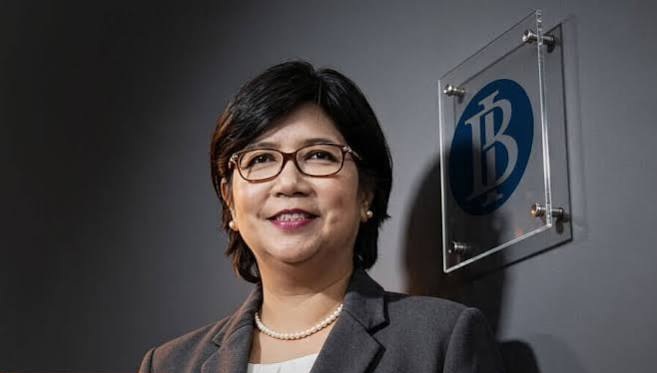
“I swear that I will carry out the duties and obligations of the BI Governor to the best of my ability and full of responsibility.” With those words, Destry Damayanti accepted the responsibility of leading Indonesia’s central bank—and, in doing so, made history as the first woman to serve as Governor of Bank Indonesia. Sworn into office in Jakarta on 2 September 2026 for the 2026–2031 term, she became the 17th Governor of the institution, bringing with her more than three decades of experience across economics, banking, capital markets, public policy, financial regulation and central banking.
A Historic Oath, A New Era
Destry’s appointment is significant not simply because she is the first woman to occupy the position, but because of the institution she now leads. Bank Indonesia sits at the centre of Indonesia’s economic architecture, with responsibility for monetary policy, financial stability and the resilience of the country’s financial system.
She assumes the role at a time when central banks worldwide are navigating geopolitical tensions, changing financial conditions, technological disruption and heightened global uncertainty. Her early message has therefore been one of continuity and stability.
For Destry, the historic nature of her appointment is accompanied by an equally significant mandate: keeping Indonesia’s economy steady in an unpredictable global environment.
From Jakarta to Cornell
Born in Jakarta on 16 December 1963, Destry’s journey began with a strong academic foundation. She earned a Bachelor of Economics from the University of Indonesia before pursuing a Master of Science in Regional Science at Cornell University in the United States.
Her early career was rooted in economic research. She worked as an assistant researcher at the Harvard Institute for International Development and later held research positions at the University of Indonesia and Indonesia’s Ministry of Finance.
These formative years developed the analytical expertise that would become one of the defining features of her professional career.
From Economist to Financial Strategist
Destry later moved into the financial sector, joining Citibank Indonesia between 1997 and 2000. She subsequently became Senior Economic Adviser to the British Ambassador to Indonesia, gaining valuable exposure to international economic and diplomatic affairs.
She also returned to academia as a researcher and lecturer while establishing herself as a prominent economist in Indonesia’s financial markets.
Her appointment as Chief Economist at Mandiri Sekuritas from 2005 to 2011, followed by her role as Chief Economist at Bank Mandiri from 2011 to 2015, placed her close to Indonesia’s banking and capital-market ecosystem.
These positions gave her practical insight into investment, financial markets, corporate decision-making and the wider economic forces affecting Indonesia.
The Policymaker Emerges
Destry’s career soon expanded into government and financial regulation.
From 2014 to 2015, she chaired the Economic Task Force at Indonesia’s Ministry of State-Owned Enterprises. She then served on the Board of Commissioners of the Indonesia Deposit Insurance Corporation from 2015 to 2019.
The experience strengthened her understanding of financial-sector oversight, institutional governance and the importance of maintaining confidence in the financial system.
By the time she moved to Bank Indonesia, Destry had already built an unusually broad professional portfolio spanning research, banking, government and regulation.
The Road to the Top
In 2019, Destry was appointed Senior Deputy Governor of Bank Indonesia. She was subsequently reappointed for a second term, allowing her to develop extensive institutional knowledge of the central bank and its policy-making processes.
Her path to the governorship accelerated in July 2026 following the resignation of Governor Perry Warjiyo. Destry was appointed Acting Governor while the process for selecting a permanent governor got underway.
President Prabowo Subianto later nominated her as the sole candidate for the position. Following her fit-and-proper assessment before Commission XI of the Indonesian House of Representatives, the DPR approved her appointment on 1 September.
The following day, Destry stood before Supreme Court Chief Justice Sunarto in Jakarta and took the oath of office.
With that oath, decades of professional preparation culminated in a historic appointment.
Stability Takes Centre Stage
While Destry’s appointment has attracted global attention because of its gender significance, her policy priorities are firmly focused on Indonesia’s economic realities.
She has emphasised stability as the central principle of her leadership, particularly as global uncertainty remains elevated.
“The stance remains the same: stability remains. In current conditions, global uncertainty is still high, so stability remains the key for us,” she said.
The statement signals a preference for continuity and disciplined economic management rather than abrupt policy shifts.
Digitalisation will also remain an important part of Bank Indonesia’s agenda, including the continued development of QRIS and Indonesia’s wider digital payment ecosystem.
Beyond the First-Woman Label
Destry’s historic status inevitably places gender in the spotlight. Yet she has questioned the tendency to define her achievement primarily through that lens.
She has stressed the importance of competence, integrity and leadership, arguing that these are the qualities that should determine who is capable of holding positions of great responsibility.
Her perspective adds another dimension to her appointment. The significance of Destry becoming Governor is not merely that a woman has broken through a traditional barrier. It is that her career demonstrates how women can build the technical expertise and institutional credibility required to lead complex economic organisations.
A Career Built for the Moment
Destry’s rise did not happen overnight.
From economic research and academia to international advisory work, commercial banking, capital markets, government, financial regulation and central banking, each stage of her career added another layer of experience.
That breadth is particularly relevant to her new responsibility. Leading a central bank requires more than an understanding of monetary policy. It demands an appreciation of markets, financial institutions, government priorities, international economic developments and the confidence of citizens and investors.
Destry enters the governorship with experience across all of these areas.
A New Chapter for Indonesia
Her tenure will ultimately be judged by how effectively Bank Indonesia maintains monetary and financial stability, responds to global economic pressures and supports a resilient financial system.
But her appointment has already changed the history of the institution.
On 2 September 2026, Destry Damayanti became the first woman to lead Bank Indonesia, placing her among the growing number of women occupying influential positions in global economic governance.
Her achievement is a reminder that the pathway to powerful leadership is built through preparation, expertise and the willingness to assume responsibility when the opportunity arrives.
Amazons Watch Celebrates a Historic Achievement
As Destry begins her five-year term, her oath serves as both a promise and a responsibility—to lead Bank Indonesia with competence, integrity and accountability.
Amazons Watch Magazine congratulates Destry Damayanti on her historic appointment as Governor of Bank Indonesia. We celebrate not only her distinction as the first woman to occupy the position, but also the remarkable professional journey that brought her to the pinnacle of Indonesia’s economic leadership.
Her story is one of experience, resilience and purposeful leadership—and a powerful reminder that women belong at every table where the future of economies and institutions is being shaped.





Comments are closed.