
By Blossom Ukoha
What does it take for a woman to earn a place on a presidential ticket once and then be trusted with it again?
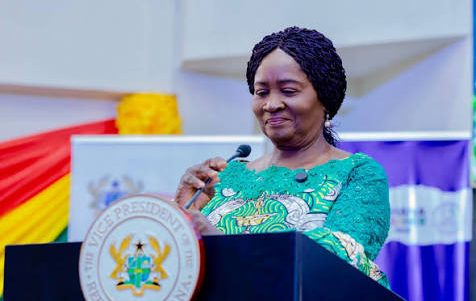
For Her Excellency, Professor Naana Jane Opoku-Agyemang, the answer is a career built on scholarship, institutional leadership, public service and a remarkable record of breaking barriers. In 2020, John Dramani Mahama chose her as his running mate. Four years later, he chose her again. This time, the ticket won. On 7 January 2025, Opoku-Agyemang was sworn in as Ghana’s first female Vice President, turning a political partnership that had appeared on the ballot twice into one of the most significant milestones in Ghanaian political history.
But the story behind that historic ticket began long before either election. It began in education.
Before the Politics, There Was the Professor
Born on 22 November 1951 in Cape Coast, Ghana, Naana Jane Opoku-Agyemang built her early career around education and scholarship. Her academic journey took her from Ghana to Senegal and Canada, eventually earning advanced degrees in literature from York University. She later joined the University of Cape Coast as a lecturer in 1986, beginning a career that would take her from the classroom to the highest levels of academic leadership.
At the University of Cape Coast, she steadily rose through the ranks, serving as Head of the Department of English, Dean of the Faculty of Arts and founding Dean of the School of Graduate Studies and Research. These positions established her not only as an accomplished academic but also as an experienced institutional leader.
Then came one of the defining moments of her career.
The Woman Who Broke Ghana’s University Glass Ceiling
In 2008, Opoku-Agyemang became the first woman to serve as Vice-Chancellor of a public university in Ghana, leading the University of Cape Coast from 2008 to 2012. Her appointment represented a significant breakthrough in a sector where senior institutional leadership had traditionally been dominated by men.
Her tenure was associated with institutional expansion and new academic initiatives, including the establishment of the Oil and Gas Institute, Faculty of Law, Amissah-Arthur Language Centre and a university crèche. Infrastructure development also included expanded lecture facilities, the university printing press and diagnostic services.
Her achievement was bigger than the title itself. By leading one of Ghana’s major public universities, she demonstrated that women could occupy the highest levels of academic administration and successfully manage institutions of national importance.
She was not simply breaking a ceiling. She was showing other women that there was another floor above it.
From University Leadership to National Policy
After decades in academia, Opoku-Agyemang took her leadership experience into government. In 2013, President John Dramani Mahama appointed her Minister for Education, placing her at the centre of Ghana’s national education policy.
The transition from university administration to national government expanded the scale of her responsibility. She was now dealing not with one institution, but with an entire education system affecting millions of young Ghanaians.
During her tenure, Ghana pursued reforms including the conversion of polytechnics into technical universities and the upgrading of Colleges of Education. Her ministry also introduced the Inclusive Education Policy, reflecting an effort to create a more equitable education system for learners with different needs.
Her years in government strengthened a theme that had already defined her academic career: education should be a pathway to opportunity rather than a privilege available only to a few.
Then Came 2020
Opoku-Agyemang’s political story took a decisive turn in 2020, when John Mahama selected her as his running mate for the presidential election. The nomination was historic. She became the first woman selected as the running mate of a major Ghanaian political party’s presidential candidate.
The ticket did not win that election.
But losing the election did not end her political journey.
Instead, it set the stage for an even more remarkable chapter.
The Ticket Twice
Four years later, John Mahama made the decision again.
In 2024, he selected Opoku-Agyemang as his running mate for a second consecutive presidential campaign. This time, the significance of the nomination was different. She was no longer simply breaking into the political space. She was returning with the experience of a former Vice-Chancellor, Education Minister, scholar and public servant behind her.
Being chosen once could be viewed as a breakthrough. Being chosen twice suggested something deeper: confidence in her leadership and the strength of the political partnership she had developed with Mahama.
When the National Democratic Congress won the 2024 presidential election, the second ticket produced the history that the first had not.
On 7 January 2025, Opoku-Agyemang was sworn in as Ghana’s first female Vice President.
The woman who had appeared on the presidential ticket twice had finally reached the office at the end of it.
When the Second Chance Becomes History
Political success is often presented as though it happens in a single defining moment. Opoku-Agyemang’s journey tells a different story.
The 2024 victory cannot be separated from everything that came before it. The professor had already spent decades building expertise. The Vice-Chancellor had already broken one institutional glass ceiling. The Education Minister had already shaped national policy. The 2020 running mate had already demonstrated that a woman could occupy a place on a major presidential ticket.
The second nomination brought those experiences together.
And the victory transformed them into history.
A Vice President With an Educator’s Lens
Her elevation to the vice presidency did not sever her relationship with education. If anything, it appears to have strengthened it.
In March 2025, during a visit by a University of Cape Coast delegation, Opoku-Agyemang reaffirmed the importance of education to Ghana’s national development agenda. Her public engagements as Vice President have also extended into women’s economic participation, entrepreneurship, engineering and human capital development.
She has engaged women entrepreneurs on issues including access to finance, childcare, agriculture and opportunities for women-led businesses. She has also met women engineers to discuss the underrepresentation of women in technical fields and the importance of encouraging more girls to pursue engineering careers.
The pattern is familiar. The professor who spent decades thinking about education and institutions is now operating at the highest level of government with many of those same concerns: who gets opportunity, who is excluded and what can leadership do to change that?
A Career Defined by Firsts
Although the “ticket twice” story is at the centre of her political journey, it is only one part of Opoku-Agyemang’s record.
She became Ghana’s first woman Vice-Chancellor of a public university. She became the first woman selected as running mate on a major Ghanaian presidential ticket. And she ultimately became Ghana’s first female Vice President.
Each first changed the boundaries of what women could imagine for themselves.
Her story demonstrates that representation becomes more powerful when it creates a pathway for others. The woman who occupies the seat today can make it easier for another woman to occupy it tomorrow.
Beyond the Symbolism
Ghana’s first female Vice President is an important symbol for women and girls across the country. But Opoku-Agyemang’s career also raises a larger question about what women bring to political leadership.
Her route to power was not built solely on political ambition. It was built on professional expertise. She spent years teaching, researching, managing academic institutions and shaping education policy before arriving at the highest levels of government.
That gives her political journey a distinctive character.
She did not simply move from politics into leadership. She moved from expertise into influence.
A Legacy Still Being Written
In March 2026, the University of Cape Coast honoured Opoku-Agyemang with its Distinguished Fellow Award, recognising her contributions to academia, governance, democracy, leadership, women and children, and national and global development.
The recognition carried particular meaning because UCC was where much of her professional journey took shape. It was where she studied, taught, rose through academic leadership and eventually became Vice-Chancellor.
Years later, the same institution was celebrating her as the woman who had moved from leading a university to helping lead a nation.
Her journey had come full circle, but it had not stopped evolving.
The Woman Who Made the Ticket Twice
Naana Jane Opoku-Agyemang’s story is not simply about being selected twice. It is about what happened between the two selections—and what happened after the second one.
The first ticket introduced a barrier-breaking woman to the centre of Ghanaian presidential politics. The second gave her another opportunity to make history. The victory that followed turned that possibility into reality.
Her journey is a reminder that leadership is rarely built in a single campaign, appointment or election. It is built over time, in classrooms, institutions, public service and even moments of disappointment.
Sometimes the first opportunity opens the door.
The second proves that you belong there.
And sometimes, the woman who gets the opportunity twice becomes the woman who makes history.





Comments are closed.