

By Blossom Ukoha
“If you’re sad, add more lipstick and attack.” — Coco Chanel
Imagine owning a beauty product so powerful that it was once associated with queens, banned by governments, embraced by suffragettes, and even worn as a symbol of resistance during wartime.
Surprisingly, that product is not a priceless jewel or an elaborate crown.
It is a tube of red lipstick.
Few beauty products have carried as much cultural, political and historical significance. For thousands of years, women have used red lipstick not simply to enhance their appearance, but to communicate confidence, status, courage and identity without saying a single word. While beauty trends have come and gone, the red lip has endured, reinventing itself across centuries as one of history’s most enduring symbols of female power.
The First Women to Wear Power on Their Lips
The story of red lipstick begins more than 5,000 years ago in ancient Mesopotamia. Around 3500 BCE, Queen Puabi, one of the most influential women of the Sumerian civilisation, stained her lips with a mixture of crushed red stones and white lead. Archaeologists later discovered lip pigments buried alongside wealthy Sumerians in ornate cockle shells, revealing that lip colour was far more than decoration. It was a visible expression of wealth, authority and social status.
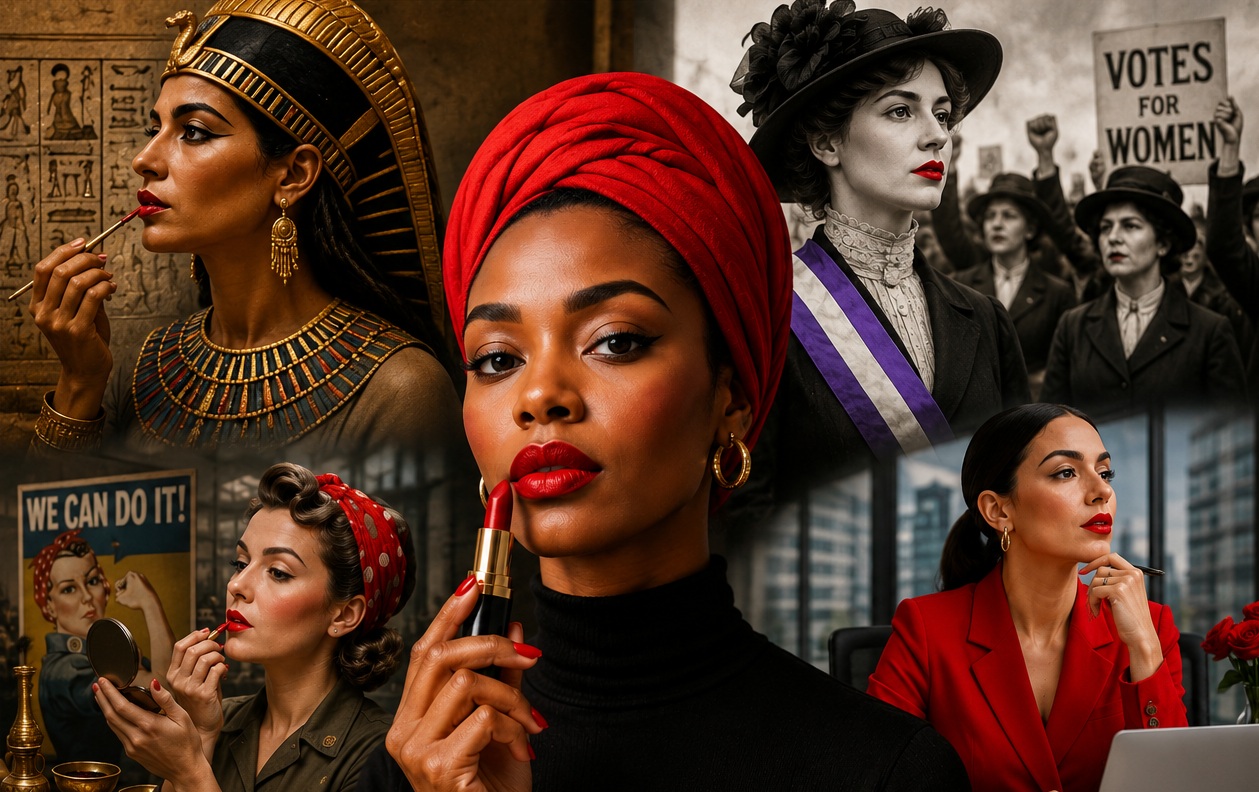
Centuries later, the tradition flourished in ancient Egypt. Cleopatra, whose beauty continues to fascinate the world, was known for wearing bold red lips created from red ochre and carmine pigments extracted from insects. To Egyptian royalty, cosmetics represented more than elegance. They symbolised divinity, protection and prestige. A striking red lip became part of the image of power itself.
When Society Feared Bold Women
History has rarely been comfortable with women who challenge expectations, and red lipstick became one of the many ways society attempted to police female expression.
In ancient Greece, red lips became associated with sex workers, who were reportedly required to wear lipstick so they could not disguise themselves as respectable women. A beauty symbol that once represented royalty had suddenly become a mark of social control.
The suspicion surrounding cosmetics intensified centuries later. In eighteenth-century England, women who used makeup, including lipstick, were sometimes accused of deceiving men. A notorious law passed in 1770 even suggested that women who used cosmetics to “trick” men into marriage could face prosecution under legislation linked to fraud and witchcraft. Although rarely enforced, the law reflected widespread anxiety about women who used beauty to express independence and influence.
The Lipstick That Joined a Revolution
The meaning of red lipstick changed dramatically in the early twentieth century when women fighting for political equality transformed it into a symbol of resistance.
During the famous 1912 New York Suffrage March, attended by approximately 20,000 women, cosmetics entrepreneur Elizabeth Arden stood outside her Fifth Avenue salon distributing tubes of red lipstick to the marchers. At a time when wearing bold lipstick was still considered provocative, the gesture was deeply symbolic. Every woman who applied it challenged the belief that femininity and political strength could not coexist.
Leading suffragettes such as Elizabeth Cady Stanton, Charlotte Perkins Gilman and British activist Emmeline Pankhurst embraced the bold red lip as a statement of confidence and independence.
Beauty historian Rachel Felder, author of Red Lipstick: An Ode to a Beauty Icon, captured its significance perfectly when she observed, “There could not be a more perfect symbol of suffragettes than red lipstick, because it’s not just powerful, it’s female.”
Although historians also remind us that women of colour often remained excluded from many early feminist victories, red lipstick nevertheless became one of the movement’s most recognisable visual symbols.
A Symbol of Courage During War
The Second World War gave red lipstick an entirely new meaning.
While Europe was engulfed in conflict, women refused to surrender the small rituals that reminded them of hope and normality. Red lipstick became a quiet but powerful expression of resilience.
It is widely reported that Adolf Hitler disliked heavily made-up women, associating bold cosmetics with values he rejected. In response, many Allied women embraced red lipstick as an act of defiance. In Britain, where cosmetics became scarce, some women even improvised by using beetroot juice to colour their lips.
Across the Atlantic, the United States military officially incorporated red lipstick into the appearance of servicewomen. Cosmetics company Elizabeth Arden created Montezuma Red, a shade designed to match the trim of women’s military uniforms. Together with the famous Victory Red, it became part of official military kits, while advertisements encouraged women to “Keep your beauty on duty.”
In difficult times, a red lip became more than beauty. It became morale.
Why Red Still Makes Women Feel Powerful
Thousands of years after Queen Puabi first coloured her lips, psychologists continue to explore why the colour red has such a profound emotional effect.
Psychiatrist Dr. Samantha Boardman believes that personal rituals such as applying red lipstick influence how people experience themselves, strengthening feelings of confidence and competence before important moments.
Similarly, evolutionary psychologist Dr. Julia Robertson argues that the colour red promotes feelings of agency, mastery, and personal strength. For many women, applying red lipstick before a presentation, an interview or a celebration is less about appearance than about mindset.
The lipstick itself does not create confidence.
It simply helps many women reconnect with the confidence they already possess.
More Than a Beauty Trend
Today, red lipstick continues to transcend fashion.
Political leaders such as Margaret Thatcher became known for their signature red lips, while American Congresswoman Alexandria Ocasio-Cortez has spoken openly about wearing lipstick as an expression of professionalism rather than vanity. Music legend Selena Quintanilla made her bold red lipstick part of her unmistakable identity, inspiring generations of women across Latin America and beyond.
Red lipstick has also appeared during feminist demonstrations in countries including Chile and Nicaragua, where women have worn it as a visible symbol of solidarity, courage and resistance.
Its meaning continues to evolve, yet its message remains remarkably consistent. It is about being seen, being heard and refusing to disappear into the background.
The Beauty Industry’s Timeless Icon
The cultural influence of red lipstick is reflected in its enduring commercial success.
The global lipstick market is estimated to be worth between US$11 billion and US$18 billion, depending on market analysis, with continued growth projected well into the next decade. Classic shades such as MAC’s Ruby Woo remain among the world’s best-selling lipsticks, proving that while beauty trends constantly change, a timeless red lip never truly goes out of style.
More Than a Colour, A Legacy
Few beauty products have travelled such an extraordinary journey.
From the royal courts of Mesopotamia and Egypt to the streets of New York’s suffrage marches, from wartime military kits to today’s boardrooms, political campaigns and protest movements, red lipstick has remained a constant companion to women determined to shape their own destinies.
Its true power has never been found in its shade or its brand. It lies in what it represents.
Confidence.
Resilience.
Courage.
Identity.
So, the next time you reach for a tube of red lipstick before an important meeting, a celebration or simply because it makes you feel your best, remember that you are wearing far more than a cosmetic.
You are wearing one of history’s boldest declarations that women have always had the power to define themselves on their own terms.





Comments are closed.