By Blossom Ukoha
The Global South is gaining economic weight. But who gets to shape the power that comes with it?
In 2026, only 28 countries have a woman serving as Head of State or Government. Women hold just 22.4 per cent of cabinet positions and approximately 27.5 per cent of parliamentary seats worldwide, according to the latest data from UN Women and the Inter-Parliamentary Union.
The figures arrive at a consequential moment for the Global South. Countries across Africa, Asia, Latin America and the Caribbean are becoming increasingly connected through new trade relationships, investment partnerships, technology exchanges and development initiatives. South-South cooperation is no longer a secondary feature of global development; it is becoming an important part of how emerging economies build collective economic strength.
The scale is already significant. According to the United Nations, South-South trade reached US$6.8 trillion in 2025, while more than half of developing countries’ exports went to other developing economies. Foreign direct investment between developing countries has also expanded considerably.
But as these relationships grow, one question deserves much greater attention: who is sitting at the tables where this new economic order is being designed?
Increasingly, women are participating in the economy. The challenge is ensuring that participation translates into influence.
Women Are Already Driving the South’s Economy
Look beyond presidential offices, ministerial meetings and diplomatic summits, and another picture emerges.
Across Africa, women are already major participants in regional commerce. The Food and Agriculture Organization estimates that women account for roughly 70–80 per cent of informal traders in Africa, making a substantial contribution to intra-regional trade and household livelihoods.
These women move agricultural products, food, textiles and other goods across borders. They develop commercial relationships, create income for their families and connect communities that formal economic statistics do not always fully capture.
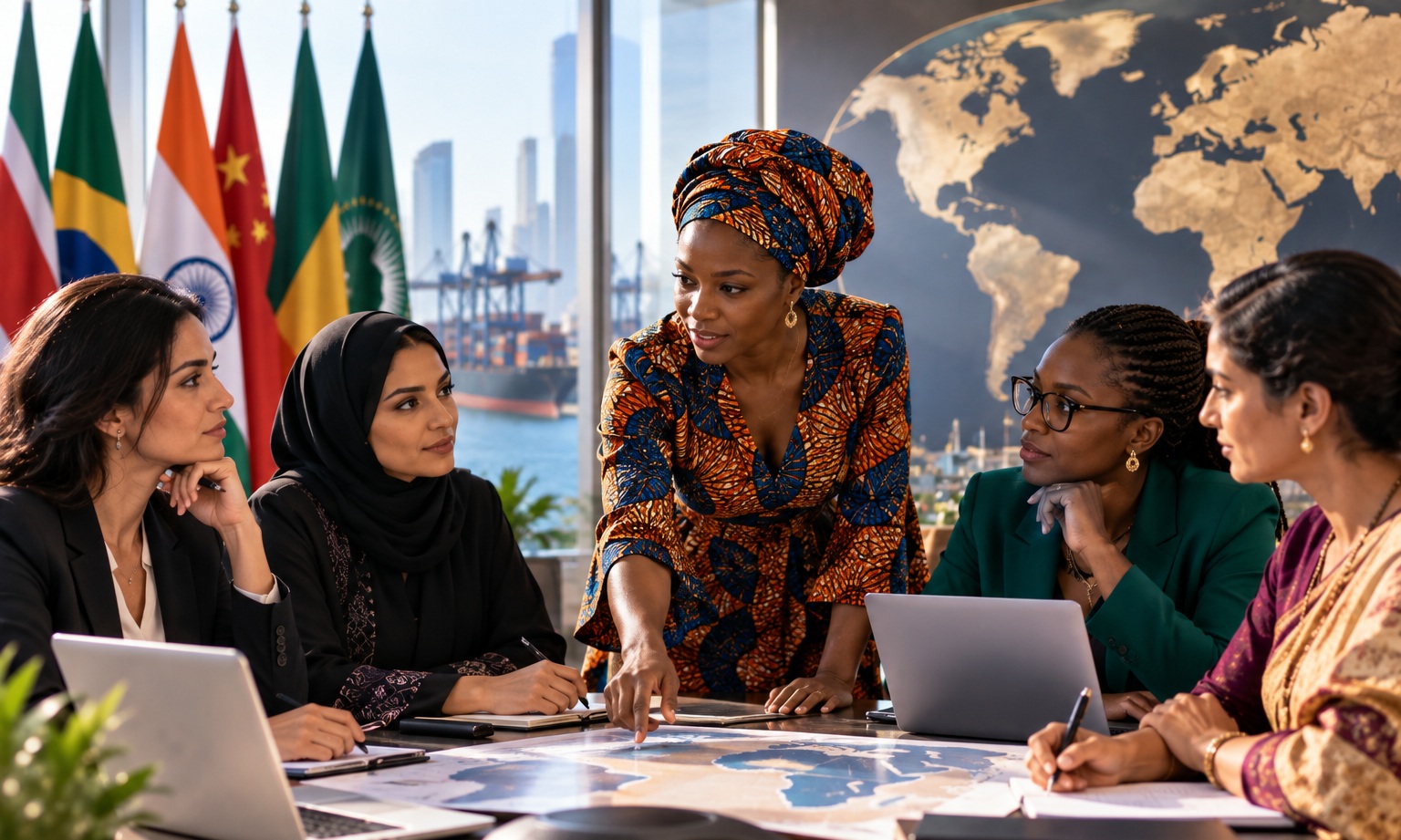
Yet many of the women participating directly in cross-border commerce remain far removed from the rooms where trade rules and regional economic frameworks are negotiated.
That contradiction matters. Women are already helping economies trade across borders, but they are still underrepresented among those deciding how those borders, markets and trading systems should work.
From Beneficiaries to Architects
For years, women’s participation in development has often been framed around what can be done for women: entrepreneurship training, grants, skills programmes and financial inclusion initiatives. These interventions can be valuable, but they are not enough for the next phase of South-South cooperation.
Women must also participate in deciding what is traded, where investment goes, which technologies receive support and how emerging markets are designed.
Africa has already taken a step in this direction. The African Union adopted the Protocol on Women and Youth in Trade under the African Continental Free Trade Area in February 2024, creating a dedicated framework for strengthening the participation of women and young people in continental trade.
But opening markets does not automatically guarantee equal access to them. Women traders and entrepreneurs continue to encounter barriers involving finance, market information, business formalisation, productive resources and access to networks. FAO identifies several of these constraints in its analysis of women’s participation in agricultural trade under AfCFTA.
The challenge is therefore not simply opening the door. It is ensuring women have the capital, connections, skills and decision-making power required to walk through it and compete.
The Missing Voice at the Decision-Making Table
The representation gap becomes particularly visible in politics and diplomacy.
Women now hold 35.6 per cent of seats in local deliberative bodies globally, according to UN Women. However, representation varies significantly between regions. Women held about 26.1 per cent of local-government seats in sub-Saharan Africa and approximately 19.8 per cent in Northern Africa and Western Asia in the latest available data.
Diplomacy tells a similar story. The 2025 Women in Diplomacy Index, produced by the Anwar Gargash Diplomatic Academy, found that women occupied 22.5 per cent of ambassadorial and permanent-representative positions globally. Africa reached about 22 per cent, while Asia stood at approximately 13 per cent.
These numbers matter because South-South cooperation is not built only through commercial transactions. It is also built through diplomatic negotiations, investment agreements, development partnerships and technology cooperation.
When women are absent from those spaces, their experiences can remain outside the design of the very systems that will determine their economic opportunities.
The Next Power Shift Is Digital and Green
The urgency becomes even greater as South-South cooperation moves into emerging sectors.
Digital trade, artificial intelligence, renewable energy, climate technology, advanced manufacturing and cross-border e-commerce are increasingly influencing economic competitiveness. These are the sectors that will help determine who creates wealth and controls new markets in the coming decades.
The African Continental Free Trade Area reflects this changing landscape, with separate protocols addressing areas including digital trade, investment, and women and youth in trade.
This creates an important opportunity for women.
A woman entrepreneur should not only receive training to use a digital platform; she should have access to the finance and markets needed to scale her business. A woman scientist should not only participate in a technology programme; she should have opportunities to influence research priorities. A woman policymaker should not simply implement a regional agreement; she should have a role in negotiating it.
The goal should therefore be more than including women in the next economy. It should be enabling women to help build it.
South-South Cooperation Can Create That Space
One of the greatest strengths of South-South cooperation is the opportunity for developing countries to exchange knowledge, technology, skills and practical solutions based on experiences that may be more relevant to one another’s realities.
The United Nations has highlighted the growing importance of South-South trade and investment as developing economies become increasingly interconnected.
That exchange can be particularly valuable for women.
A successful women-led digital-finance model in one African country can provide lessons for another. A trade policy developed in Latin America can inform reforms elsewhere. An agricultural innovation developed in Asia can potentially be adapted to support women farmers in Africa.
But these exchanges must be intentional. Women should not simply be included as beneficiaries after programmes have been designed. They should be involved in designing, financing, implementing and evaluating them.
The Seat at the Table Must Be Real
The evidence points towards a clear set of actions.
Governments should increase women’s participation in trade negotiations, diplomatic delegations, investment forums and development partnerships. Financial institutions should strengthen access to capital for women-led businesses seeking to enter regional and international markets. Businesses can create procurement and supply-chain opportunities for women-owned enterprises. Development institutions should measure not only how many women benefit from programmes, but how many women help design and govern them.
Women also have a role to play in claiming these spaces. Building cross-border networks, entering emerging sectors, pursuing regional markets and developing expertise in areas such as technology, finance and trade can position more women to influence the economic systems taking shape around them.
But responsibility cannot rest with women alone. Institutions must create pathways through which talent can become authority and participation can become decision-making power.
The Future of the Global South Needs Her Voice
The Global South is entering a new economic chapter. Its markets are becoming more interconnected, trade relationships are expanding, technology ecosystems are developing and South-South trade reached US$6.8 trillion in 2025, according to the United Nations.
The question is whether women will be allowed to participate fully in shaping what comes next.
Women are already contributing as traders, entrepreneurs, scientists, diplomats, investors, policymakers and innovators. Their participation is not hypothetical; it is visible across economies and communities throughout the Global South.
What remains unresolved is the gap between contribution and influence.
South-South cooperation offers an opportunity to close that gap—not by treating women simply as beneficiaries of development, but by recognising them as economic actors and decision-makers capable of shaping the systems being built.
The next power shift in the Global South should therefore not simply be about new markets, new alliances or new centres of economic influence.
It should also be about who gets to shape them. And women must be at the centre of that conversation.




Comments are closed.