

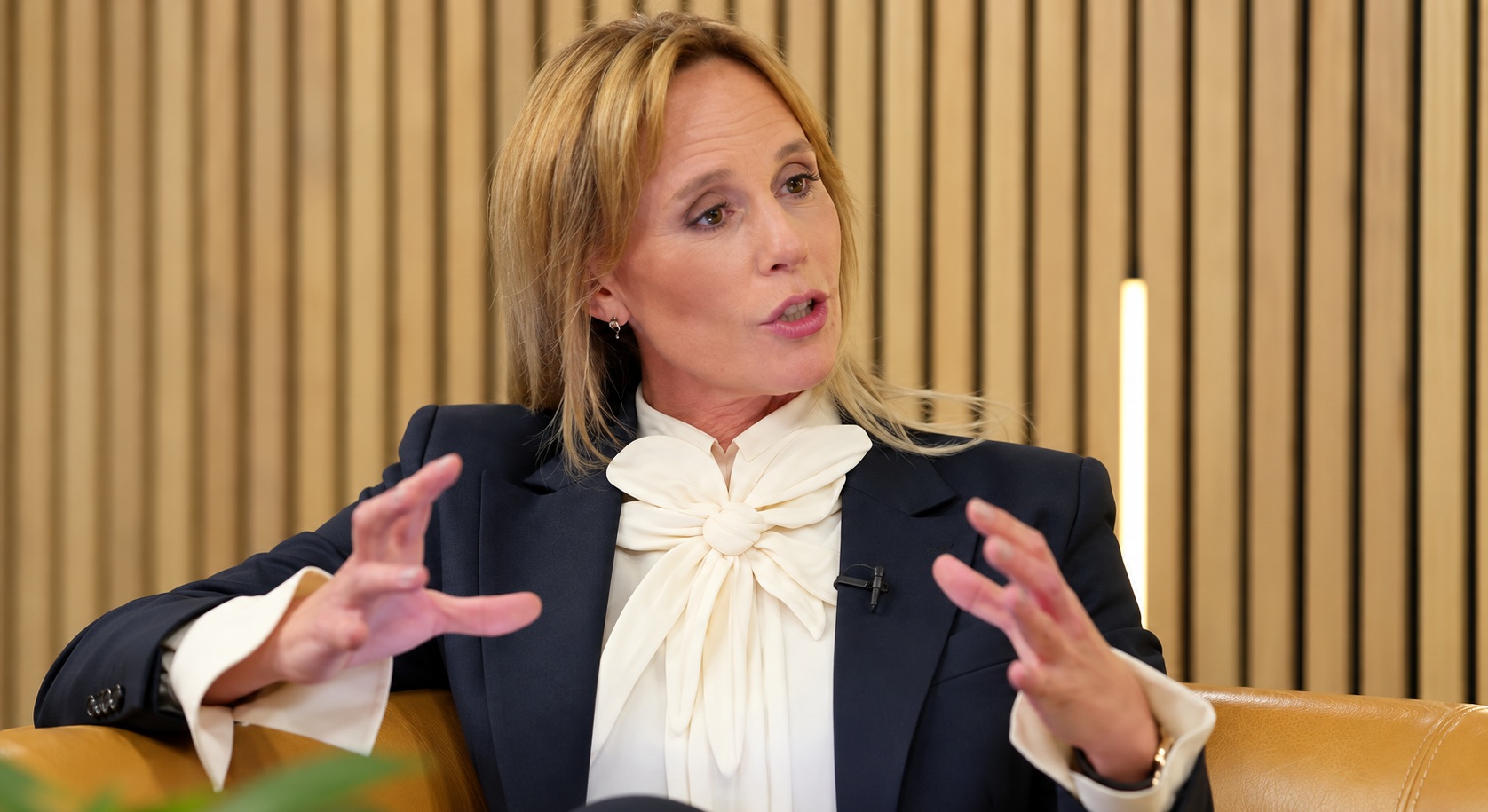
By Blossom Ukoha
A career does not always move in a straight line. For Emrie Brown, it has looked more like what she calls a “jungle gym” than a traditional ladder, a journey shaped by different roles, unexpected turns, difficult decisions and opportunities to begin again.
“Your career can be much more like a jungle gym than the traditional career ladder in your journey to achieve success,” Brown has said. “How you define success and the sacrifices that you are prepared to make, are decisions that will be required along the way and will be different for each person.”
Her own career is a powerful illustration of that philosophy. From qualifying as a chartered accountant to becoming an investment banker, taking a temporary step away from the industry to navigate motherhood, returning to RMB and eventually becoming its first woman CEO, Brown’s path demonstrates that professional success does not always follow a predictable route.
Building Her Career at RMB
Brown qualified as a Chartered Accountant (CA(SA) cum laude) in 1994, beginning her career at KPMG before moving to Nedbank.
She joined Rand Merchant Bank (RMB) in 2001, beginning a relationship with the institution that would span more than two decades.
Her progression through RMB was marked by increasingly significant responsibilities. In 2006, she became Head of Acquisition and Leveraged Finance, becoming the first woman at the bank to lead a profit centre.
She later moved into business development in Cape Town before becoming co-head and subsequently sole head of RMB’s Investment Banking Division between 2015 and 2019.
She then became Head of the Banking Division before being appointed CEO in October 2022.
Her career therefore reflects the very “jungle gym” philosophy she describes: different functions, different challenges and different forms of responsibility gradually preparing her for the top position.
The Chapter That Changed Her Perspective
One of the most personal turning points in Brown’s career came when she briefly left investment banking.
Around 2009–2010, she resigned because she believed the demands of investment banking and motherhood could not be reconciled.
Within approximately six months, she realised she had made a mistake and returned to RMB.
Looking back, she acknowledged that she had underestimated what was possible.
“In the moment, I didn’t appreciate the significance of it,” she has said.
Her experience ultimately changed her perspective:
“You can be an investment banker, have a client-facing role, and be a mother.”
That chapter became more than a personal lesson. It became part of Brown’s perspective on the structural and cultural pressures women can encounter in demanding professions.
Her story does not suggest that every woman must make the same choices. Instead, it demonstrates that career decisions can evolve as circumstances and perspectives change.
Becoming RMB’s First Woman CEO
On 1 October 2022, Brown became CEO of RMB, succeeding James Formby.
Her appointment made her the first woman to lead the corporate and investment banking institution.
RMB forms part of FirstRand, one of Africa’s largest financial groups, alongside businesses including FNB and WesBank.
Brown entered the CEO role after more than 20 years inside the organisation, giving her an unusually deep understanding of its clients, people and business model.
Reflecting on her appointment, she said:
“I am following in the footsteps of remarkable CEOs before me who have built a business that I am proud to have been a part of for most of my banking career.”
Her appointment was therefore both a personal milestone and a significant development in RMB’s leadership history.
Leading Through a Challenging Financial Environment
Since Brown took the helm, RMB has continued to operate against a backdrop of economic uncertainty and changing financial conditions.
In the second half of 2024, RMB’s normalised profit before tax increased 9% to R6.7 billion. Its South African operations grew by 11%, while its broader African portfolio continued to show resilience in local-currency terms.
Investment banking remained a strong contributor, while net interest income and deposits recorded healthy growth. Credit impairments also declined.
These results provide context for the scale of Brown’s responsibility.
As CEO, she is not simply responsible for representing women in finance. She is responsible for leading a major corporate and investment banking franchise whose clients include large businesses and institutions.
Her leadership is ultimately measured through the performance and resilience of the business.
“If You Can See Her, You Can Be Her”
Yet Brown recognises that occupying the CEO office carries significance beyond financial performance.
She has described the importance of being visible to young women considering careers in financial services.
“For a long time in my career I’ve been a role model,” she has said, adding that she wants young women to see that “it is possible for women to attain these leadership roles.”
Her message has become particularly memorable:
“If you can see her, you can be her.”
The statement captures why representation can matter even when leaders themselves prefer to be judged by performance rather than gender.
A woman leading a major investment bank makes a previously unfamiliar career possibility visible.
Making Space for Different Voices
Brown’s leadership philosophy also extends beyond gender.
She has argued that diversity includes differences in race, education, qualifications and background.
“It’s not that it’s hard being a woman but it can be hard being a minority voice,” she has said.
For her, the challenge is not simply having diverse people in the room. It is ensuring that different perspectives can actually be expressed and considered.
She believes diversity can strengthen businesses by introducing perspectives that might otherwise be overlooked.
At RMB, this philosophy is closely connected to her emphasis on people.
“I deeply value diversity. The essence of my role at RMB revolves around creating an environment that is inclusive and where people have a sense of belonging,” she has said. “I value people. I think that our people are absolutely key to our success.”
The Responsibility of Being First
Being the first woman to lead a major institution also creates a responsibility that Brown openly acknowledges.
“I think this places a big responsibility on me and other women in leadership positions to pave the way for young women to rise through the ranks.”
Her career offers one possible pathway.
She became the first woman to lead an RMB profit centre, moved through increasingly senior investment-banking positions, led major divisions and eventually became CEO.
Each position expanded what women could see as possible within the organisation.
Beyond the CEO Chair
Brown’s position also highlights the distinction between executive leadership and ownership of capital.
As RMB CEO, she has substantial responsibility for strategy, people, clients, culture and execution.
However, RMB operates within FirstRand, a listed group whose capital is ultimately held by shareholders.
FirstRand’s 2025 annual financial statements show the Public Investment Corporation as its largest shareholder, with approximately 15.7%, alongside BEE partners and other institutional investors.
Brown therefore has significant influence over the business she leads, but her executive position does not mean she personally controls the majority of the capital behind the parent group.
The distinction matters because corporate power has several dimensions: leadership, ownership, investment and capital allocation are not interchangeable.
A Different Definition of the Career Ladder
Emrie Brown’s story challenges the idea that successful careers must follow a perfectly linear path.
Her journey includes professional achievement, leadership progression, motherhood, a temporary departure, a return and ultimately the top job at RMB.
It is precisely why her “jungle gym” metaphor resonates.
A career can move sideways before moving upward. It can pause. It can change direction. It can involve decisions that are later reconsidered.
What matters is not that every step looks perfect from the outside, but that each chapter can contribute something to the person eventually taking on greater responsibility.
For Brown, that journey has led to a historic position at one of Africa’s leading investment banks.
And her message to the women watching is clear: they do not have to follow someone else’s definition of the perfect career.
They can build their own path and, in doing so, create a path that the women coming after them can see.





Comments are closed.