
By Blossom Ukoha
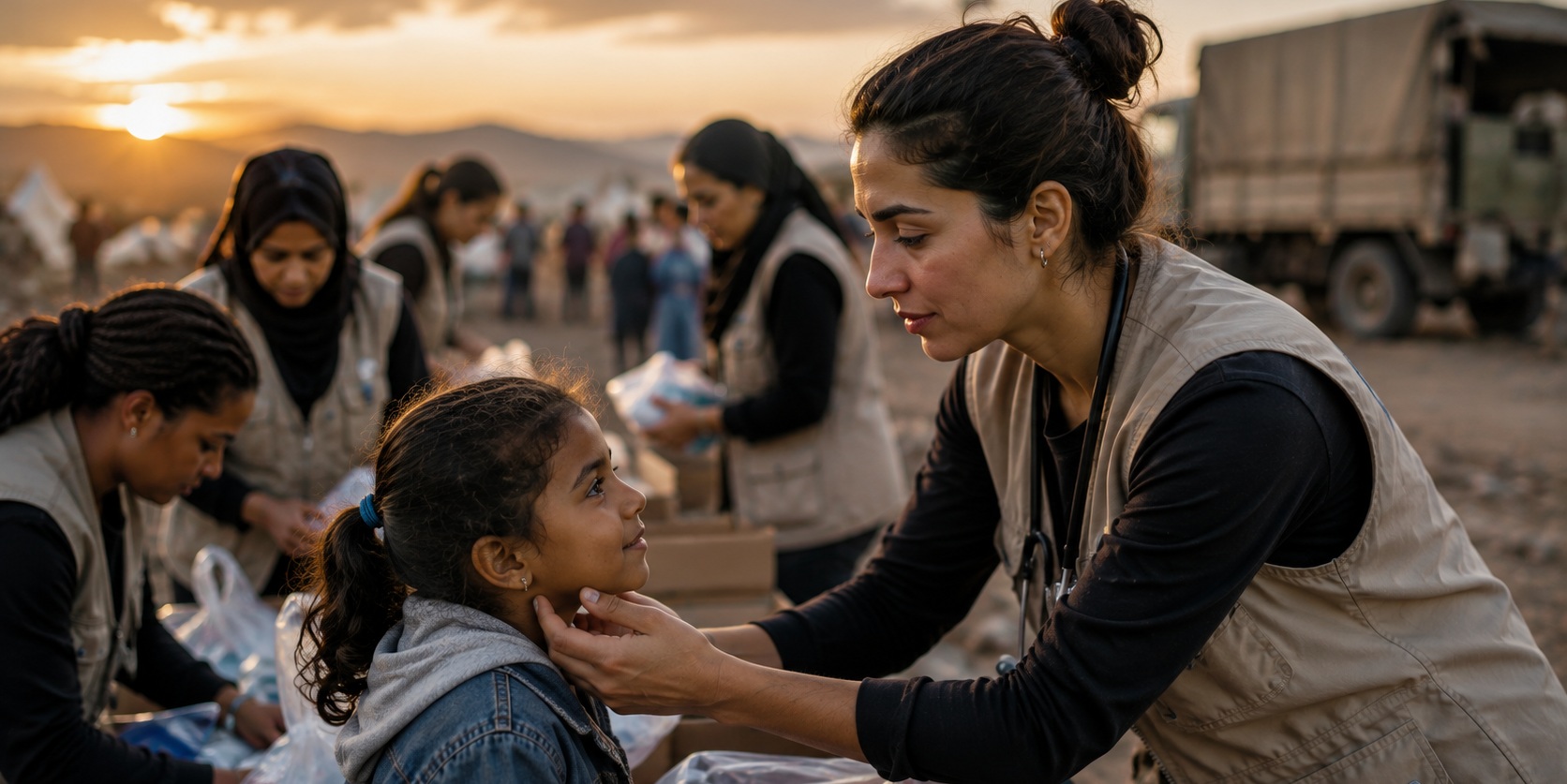
At a time when the world is witnessing wars, displacement, hunger and humanitarian emergencies on an unprecedented scale, there are women walking directly into the places others are trying desperately to escape. They are doctors treating patients in damaged hospitals, nurses working through shortages, social workers supporting survivors, community organisers protecting girls, aid workers distributing food and local leaders keeping families connected to essential services. They do not always make international headlines, but for the communities they serve, their presence can mean the difference between despair and hope.
This World Humanitarian Day, 19 August, Amazons Watch Magazine celebrates these women. We acknowledge the risks they take, the sacrifices they make and the extraordinary leadership they demonstrate every day. The United Nations’ 2026 campaign calls on the world to #ActForHumanity, at a time when humanitarian workers themselves are increasingly under attack. According to the United Nations Office for the Coordination of Humanitarian Affairs, at least 326 humanitarian workers were killed across 21 countries in 2025, bringing the number killed over the three-year period to more than 1,010.
Behind those statistics are human beings who chose to serve others despite extraordinary danger.
The Scale of the Humanitarian Need
The need facing women and girls is enormous. According to UNFPA’s 2026 Humanitarian Action Overview, more than 64 million women and girls of reproductive age will require some form of humanitarian assistance this year. Within the 43 countries covered by its appeal, more than 7.8 million women are expected to be pregnant and will need care to give birth safely, while an estimated 84 million people will require gender-based violence prevention and response services.
UN Women estimates that approximately 120 million women and girls worldwide require humanitarian assistance and protection. These numbers tell us something important: humanitarian action cannot be effective if it does not respond to the distinct realities of women and girls.
And this is precisely where women humanitarian workers become indispensable.
Women Are Responding on the Front Lines
Women are not simply recipients of humanitarian assistance. They are among the people delivering it.
According to UN Women, women-led organisations are often the first to respond and the last to leave during crises. They operate in places where international organisations may face restrictions or limited access, relying on community relationships and local knowledge to reach vulnerable women and girls.
UN Women’s July 2026 report, Beyond the Breaking Point, surveyed 855 women-led and women’s rights organisations across 52 crisis- and conflict-affected countries. The findings reveal both the extraordinary demand for their work and the enormous pressure under which they operate. Eighty-four per cent reported that demand for their services had increased since January 2025, while nearly nine in ten said they could no longer meet current levels of need. Two in five expected their organisations to close, temporarily or permanently, within the following year.
Most strikingly, UN Women reported that at least one million women and girls have lost access to critical support since January 2025 because of funding cuts affecting these organisations.
This is where the story becomes deeply personal.
When a women’s organisation closes, a survivor may lose access to protection. A displaced mother may lose food assistance. A girl may lose a safe space. A pregnant woman may lose access to essential healthcare. Behind every funding decision are real lives.
Courage in the Face of Violence
The risks facing humanitarian workers exist alongside an alarming rise in violence against women and girls.
According to the United Nations Secretary-General’s 2026 report on conflict-related sexual violence, the UN verified 9,788 cases in 2025, more than double the number documented in 2024. Women and girls accounted for more than 90 per cent of UN-verified cases. The UN also stresses that these figures represent only documented cases, meaning the actual scale is likely considerably higher because sexual violence remains severely underreported.
In such environments, women humanitarian workers often provide some of the most essential services: medical care, psychosocial support, safe spaces, legal assistance, protection and referrals for survivors.
They are serving women at the moment when those women are most vulnerable.
They Are the Women Behind the Response
There is something profoundly powerful about a woman humanitarian worker entering a crisis zone while knowing that she, too, could become a victim of the crisis.
She may have her own family waiting at home. She may worry about her safety. She may be working with inadequate resources. Yet she continues because people in her community are depending on her.
According to UN Women, nearly two-thirds of the organisations surveyed reported that their staff were working without pay to keep critical support running, while almost half reported increasing burnout among their teams.
This is not sustainable. But it demonstrates the extraordinary commitment of women who continue to serve even when the systems supporting them are weakening.
Beyond Survival: Women Are Building Resilience
Amazons Watch Magazine believes these women should not be portrayed only through the hardships they endure. They should also be celebrated for the communities they strengthen.
A woman humanitarian worker can be a healthcare provider, a peacebuilder, an educator, a protector, an advocate and a leader at the same time. She may help a survivor rebuild her life while advocating for better protection policies. She may distribute emergency supplies while organising women to participate in community decision-making.
This is leadership in its most practical form.
It is leadership that does not wait for perfect conditions.
It is leadership that responds.
AWM’s Call to Honour the Amazons on the Front Lines
This World Humanitarian Day, Amazons Watch Magazine calls on our readers to look beyond the statistics and recognise the women behind them.
Who is the woman in your community who has spent years helping displaced families? Who is the female doctor working in a conflict-affected region? Who is the humanitarian volunteer supporting survivors of violence? Who is the woman leading an organisation that continues to serve even when funding is disappearing?
Tell us her story. Nominate her. Celebrate her.
Send the name and story of an exceptional woman humanitarian worker to info@amazonswatchmagazine.com. Her work deserves to be seen, her contribution deserves to be acknowledged and her courage deserves to inspire another generation.
In conclusion, World Humanitarian Day is a moment to remember that behind every humanitarian response are people who choose service in the face of uncertainty.
This year, Amazons Watch Magazine honours the women among them.
We honour the women who enter dangerous communities to deliver care. We honour those who stand beside survivors. We honour those who keep safe spaces open when funding disappears. We honour the local women who remain when international attention moves elsewhere.
And we honour the women who continue to serve while carrying their own fears, responsibilities and sacrifices.
They are not simply aid workers. They are doctors, protectors, peacebuilders, advocates, mothers, leaders and Amazons on the front lines of humanity.
This World Humanitarian Day, let us not only thank them.
Let us protect them. Fund them. Listen to them. And tell their stories.





Comments are closed.