By Blossom Ukoha
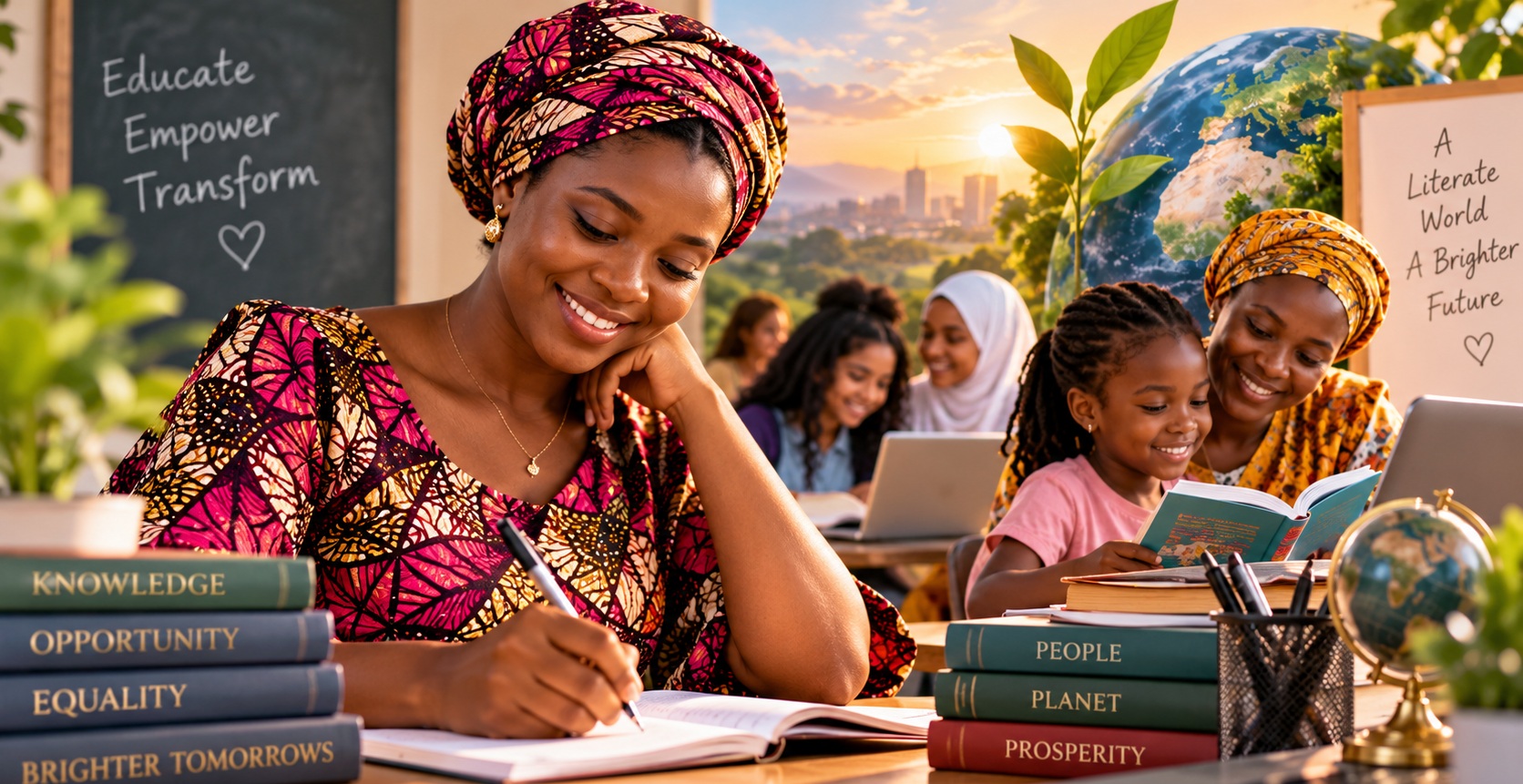
At 42, a woman in a rural community in northern Nigeria sits with a notebook on her lap, slowly tracing letters she was never taught to read as a child. For years, she depended on others to read medicine labels, interpret bank messages, complete forms and calculate prices for her small business. Now, through an adult literacy programme, she is learning to read customer messages on her phone, record her daily sales and support her children with their schoolwork. What she is gaining is more than the ability to read and write; she is gaining the confidence to make decisions for herself.
Her experience represents the reality of millions of women worldwide whose opportunities have been restricted by limited access to education. On 8 September 2026, the world marks International Literacy Day and the 60th anniversary of UNESCO’s proclamation of the observance. UNESCO proclaimed the day on 26 October 1966, with the first International Literacy Day observed on 8 September 1967. Six decades later, literacy remains one of the world’s most important development challenges.
60 Years of Progress, But Who Is Still Being Left Behind?
Global literacy has improved significantly. Approximately 88 per cent of adults worldwide are now literate, while youth literacy stands at about 93 per cent. Yet at least 739 million adults and young people still lack basic literacy skills. Most concerning is the gender imbalance: nearly two-thirds of the world’s illiterate adults are women, representing approximately 466 million women.
While the gender gap has narrowed considerably since the 1970s, progress has not been evenly distributed. Women and girls in low-income communities, rural areas and countries affected by poverty, conflict and displacement continue to face significant barriers. Parts of sub-Saharan Africa and South Asia remain among the regions where literacy gaps are particularly pronounced.
These numbers remind us that literacy is not simply an education statistic. Behind every percentage is a woman who may struggle to read a prescription, complete a government form, manage a financial transaction, access information or help her child with schoolwork.
Literacy Is a Woman’s Passport to Opportunity
The 2026 theme, “Literacy for people, the planet and prosperity,” captures the expanding importance of literacy in a rapidly changing world. For people, it represents dignity, inclusion, lifelong learning and greater equality. For the planet, it encompasses environmental awareness and the ability to understand sustainability and climate-related information. For prosperity, it provides the foundation for employment, entrepreneurship, financial inclusion and future-ready skills.
For women, these three dimensions are inseparable.
Literacy can strengthen a woman’s economic independence by enabling her to manage finances, understand contracts, apply for jobs, operate a business and access wider markets. Education is also associated with increased earning potential, with each additional year of schooling estimated to increase earnings by about nine per cent.
But the value of literacy extends far beyond income. A literate woman is better positioned to understand healthcare information, make informed decisions about nutrition and reproductive health, support childhood vaccination and participate actively in her children’s education. Girls who receive education are also more likely to marry later and exercise greater agency in decisions affecting their lives.
When a Mother Learns, the Future Learns
Perhaps the most powerful argument for women’s literacy is its multiplier effect.
A woman who acquires literacy skills does not necessarily keep that knowledge to herself. She can pass it to her children, encourage school attendance, support homework and create a home where learning is valued. Her increased confidence can influence how she participates in her community, manages her household and engages with institutions.
This makes women’s literacy an investment that can produce returns across generations. Breaking one woman’s cycle of educational exclusion can help prevent the same cycle from being repeated by her children.
The New Literacy: Digital, Financial and Environmental
Literacy in 2026 must also mean more than traditional reading and writing. As economies become increasingly digital, women need digital and financial literacy to participate safely and effectively.
A woman may know how to read but still struggle to navigate digital banking, identify online fraud, understand financial products or promote her business through digital platforms. Without these skills, technological advancement can deepen rather than reduce inequality.
Environmental literacy is equally important. Climate change is affecting agriculture, food security, water availability and livelihoods, particularly in vulnerable communities. Women must have access to understandable information that enables them to respond to environmental challenges and participate in sustainable solutions.
Nigeria’s Adults Deserve a Second Chance
Nigeria’s 2026 observance has placed renewed emphasis on adult education. First Lady Oluremi Tinubu has called for greater attention to adult learning, highlighting the importance of reading, writing, digital and financial skills for adults, particularly women.
The message is significant: education should not have an expiration date.
Women who missed school because of poverty, early marriage, family responsibilities or other circumstances should not be permanently excluded from learning. Adult literacy programmes, flexible education models and second-chance learning can provide pathways back into education and economic participation.
From Celebration to Commitment
The global International Literacy Day celebration is taking place on 8–9 September 2026 in Chiapas, Mexico, beginning in the Indigenous community of San Juan Chamula and continuing in San Cristóbal de las Casas. The programme includes the UNESCO International Literacy Prizes, recognising six programmes from Colombia, Lebanon, Mexico, the Kingdom of the Netherlands, Nigeria and Thailand.
The recognition of successful programmes is encouraging, but celebration alone cannot close a literacy gap affecting hundreds of millions of people.
The world must invest in quality education, adult literacy, second-chance programmes and gender-responsive learning. Governments, development organisations, businesses, communities and individuals all have a role to play in ensuring that women are not excluded from the knowledge economy.
A Call from Amazons Watch Magazine
At Amazons Watch Magazine, we believe that empowering women begins with giving them access to the knowledge and opportunities they need to shape their own lives. International Literacy Day 2026 should therefore be more than a commemoration; it should be a call to action.
We call on governments to strengthen funding for women’s and adult literacy programmes, on businesses and philanthropists to invest in digital and financial education, and on communities to create safe and accessible learning opportunities for women and girls. We also urge organisations working on gender equality and development to make literacy central to their empowerment strategies.
No woman should be considered too old to learn, too poor to be educated or too far behind to begin again.
Sixty years after International Literacy Day was proclaimed, the unfinished work is clear. If we want people to thrive, the planet to be protected and prosperity to be shared, we must ensure that women have the knowledge to participate.
Because when a woman gains the power to read, understand, decide and act, she does not simply change her own story, she can change the story of generations.





Comments are closed.