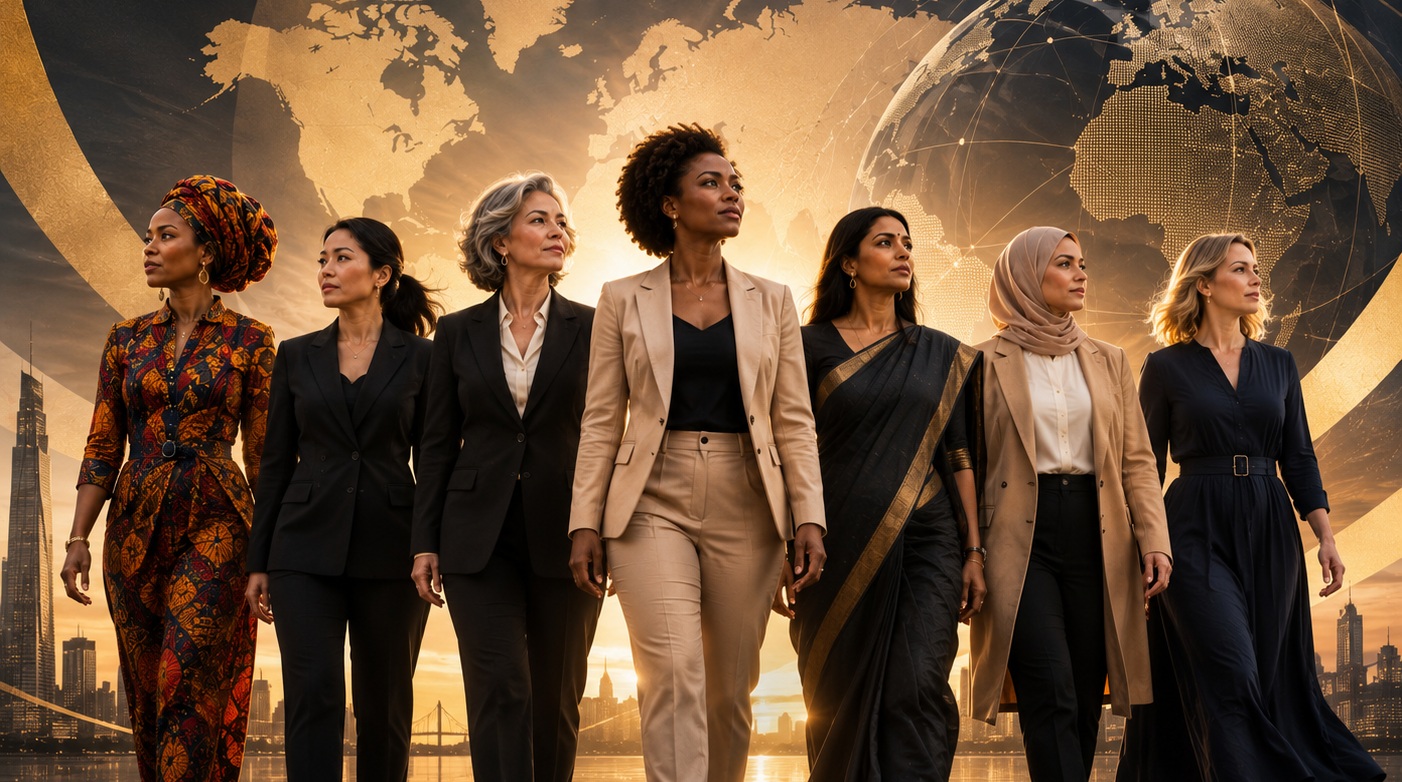
As global power shifts, will women help shape the next world order—or be left behind?
According to the 2026 Women in Politics Map, jointly published by UN Women and the Inter-Parliamentary Union (IPU), the world remains far from achieving gender-balanced leadership. Only 28 countries are currently led by a woman as Head of State or Government, while 101 countries have never had a female leader. Women occupy just 22.4% of cabinet minister positions globally, 27.5% of parliamentary seats, and only 19.9% of Speaker of Parliament positions, a decline that marks the first reversal in more than two decades. At the current pace, the IPU and UN Women estimate that gender equality in the world’s highest executive offices remains approximately 130 years away.
The picture is equally concerning in business. The World Economic Forum (WEF) reports that the global gender gap is 68.8% closed, leaving the world approximately 123 years away from full gender parity, while women continue to occupy only around one-fifth of CEO positions worldwide. Progress has been made, but it has slowed dramatically and in some areas, it has begun to reverse.
Yet these statistics emerge at a time when the world itself is changing.
A new international order is taking shape, one defined less by the dominance of a handful of Western powers and more by the rise of multiple centres of influence across Asia, Africa, Latin America and the Middle East. This emerging multipolar world is not only reshaping geopolitics and the global economy; it is redefining leadership itself.
The question is no longer whether women are capable of leading. The question is whether the emerging global order will finally create the conditions for women to lead at the scale the world now requires.
The Rise of a Multipolar World
For more than three decades after the Cold War, global politics was largely influenced by a Western-led international order. Today, however, economic growth, diplomatic influence and technological innovation are increasingly being driven by emerging powers such as China, India, Brazil, Indonesia, Saudi Arabia, Nigeria and Mexico.
Power is becoming more dispersed.
Trade partnerships are expanding beyond traditional alliances. Regional blocs are becoming more influential. Developing economies are playing larger roles in climate negotiations, global finance and international governance.
This redistribution of influence presents an opportunity to rethink who leads and how leadership is exercised.
Unlike previous eras that often rewarded hierarchical leadership, the multipolar world demands collaboration, coalition-building, adaptability and consensus across cultures and political systems.
These are qualities increasingly associated with successful women leaders across politics, diplomacy and business.
Progress Is Real but Fragile
Although women’s representation has improved over the past two decades, the pace has slowed significantly.
According to UN Women and the Inter-Parliamentary Union, women now hold 27.5% of parliamentary seats worldwide, an increase of only 0.3 percentage points from the previous year, the slowest rate of growth in recent history. At this pace, gender parity in national legislatures is not expected until around 2063.
Even more concerning is the decline in executive representation.
Women now occupy 22.4% of cabinet minister positions, down from 23.3% in 2024, making 2026 one of the few years in which global representation has moved backwards. Only 14 countries have achieved gender parity in their cabinets, while eight countries still have no female cabinet ministers at all.
Leadership at the highest parliamentary level has also declined. Women account for only 19.9% of Speakers of Parliament, representing the first global decrease in 21 years.
These figures serve as a reminder that progress is neither automatic nor permanent.
Corporate Leadership Faces the Same Challenge
Politics is not the only arena where women remain underrepresented.
According to the Grant Thornton Women in Business Report 2026, women hold approximately 31–34% of senior management positions globally. Yet the leadership pipeline narrows dramatically at the highest levels.
Women account for only 19–21% of chief executive officers, while they occupy roughly 24.6% of C-suite positions overall.
Boardrooms have become more diverse, with women now holding approximately 29% of board seats among the world’s largest listed companies, according to Deloitte’s Women in the Boardroom report. However, only 8.4% of board chair positions are held by women, demonstrating that true leadership parity remains elusive.
Current projections suggest that gender parity in business leadership will not be achieved until approximately 2051.
Why Multipolarity Could Accelerate Female Leadership
One of the most encouraging developments of recent years is that some of the world’s most significant breakthroughs for women are no longer occurring exclusively in Western democracies.
In Mexico, Claudia Sheinbaum became the country’s first female president, leading one of the world’s fifteen largest economies.
In Italy, Giorgia Meloni continues to serve as Prime Minister, becoming one of Europe’s most influential political figures.
Across Latin America, women have increasingly occupied presidential offices, demonstrating that female executive leadership is becoming more normalized throughout the region.
In Africa, Rwanda continues to lead the world in female political representation, with women holding approximately 64% of parliamentary seats, the highest proportion globally.
These examples demonstrate that the future of female leadership is increasingly being shaped by emerging economies and Global South nations rather than following traditional Western political trajectories alone.
As new centres of global influence emerge, so too do new pathways for women to reach the highest levels of leadership.
Why Women’s Leadership Matters
The argument for women’s leadership has evolved far beyond questions of equality.
Increasingly, it is recognised as an economic, governance and security imperative.
Research published by the World Economic Forum indicates that countries with higher levels of female political representation consistently perform better in areas such as labour market participation, social investment and long-term economic development. WEF analysis further suggests that increasing women’s parliamentary representation by 10 percentage points is associated with stronger GDP growth.
Commenting on the release of the 2026 Women in Politics Map, Tulia Ackson, President of the Inter-Parliamentary Union, said:
“Women bring perspectives and experience that are essential for making better decisions, preventing conflict and building lasting peace. When women are fully involved in political leadership, countries are more stable, policies work better for people, and societies are better prepared to face the crises shaping our world today. Parity is a moral imperative… but it is also the smart thing to do. Institutions make better decisions when they reflect the societies they serve.”
— Tulia Ackson, President, Inter-Parliamentary Union (IPU), 2026 Women in Politics Map
Similarly, UN Women and the Inter-Parliamentary Union emphasised the consequences of excluding women from decision-making:
“When women are shut out of political leadership, decisions that shape peace, security and economic priorities are made without half of the world’s experience at the table.”
— UN Women & Inter-Parliamentary Union, Women in Politics: 2026
Former Liberian President Ellen Johnson Sirleaf and former Ethiopian President Sahle-Work Zewde have likewise urged the international community to embrace stronger female leadership, stating:
“Let women lead. From peacekeeping to hunger, health to climate, the world will benefit. In a time of crisis, the United Nations must encourage strong female leadership.”
— Ellen Johnson Sirleaf & Sahle-Work Zewde
Their message reflects a growing consensus among policymakers, economists and development experts: inclusive leadership is no longer simply desirable, it is essential.
The Challenges That Still Stand in the Way
Despite encouraging breakthroughs, structural barriers remain deeply entrenched.
Women continue to face unequal campaign financing, political violence, online harassment, discriminatory social norms and limited access to influential political networks.
Corporate leadership pipelines remain disproportionately male at executive levels despite increasing numbers of women entering management.
Without deliberate action, including stronger leadership pipelines, gender-responsive political financing, mentorship, institutional reforms, protection from political violence and inclusive governance policies, the promise of the multipolar world could easily replicate the inequalities of the old one.
The Next Decade Will Define the Future
The coming decade will determine whether the emerging multipolar order becomes a catalyst for greater inclusion or simply redistributes power among the same traditional elites.
The nations that thrive will be those capable of drawing on the full spectrum of their talent.
Women are already leading governments, central banks, multinational corporations, international organisations and diplomatic institutions across every region of the world.
What remains is not proof of their capability, but the political will to remove the barriers that continue to limit their participation.
As the architecture of global power is rewritten, female leadership should not be viewed as an exception to the rule.
It should become one of its defining features.
The emergence of a multipolar world offers more than a geopolitical shift, it offers a leadership reset. Nations are searching for new ideas, new partnerships and new approaches to solving increasingly complex global challenges. Women have consistently demonstrated the ability to lead through collaboration, resilience and innovation, yet the data shows they remain significantly underrepresented where the most consequential decisions are made. If the next world order is to be more inclusive, more resilient and more sustainable than the last, it cannot afford to overlook half of humanity’s leadership potential. The future of global leadership will not simply be measured by which countries become more powerful, but by which societies are courageous enough to ensure that power is shared.



Comments are closed.