

By Blossom Ukoha
For years, women have worn smartwatches that could count their steps, measure their heart rates and analyse their sleep, yet offered remarkably little insight into some of the most important changes happening inside their bodies.
Imagine waking in the middle of the night with an unexplained hot flash, struggling with an irregular menstrual cycle or wondering whether an unusual symptom is simply hormonal. You reach for your wearable, expecting technology to have an answer. Instead, there is often very little data to explain what your body is doing.
That gap is what a new generation of women innovators is determined to close.
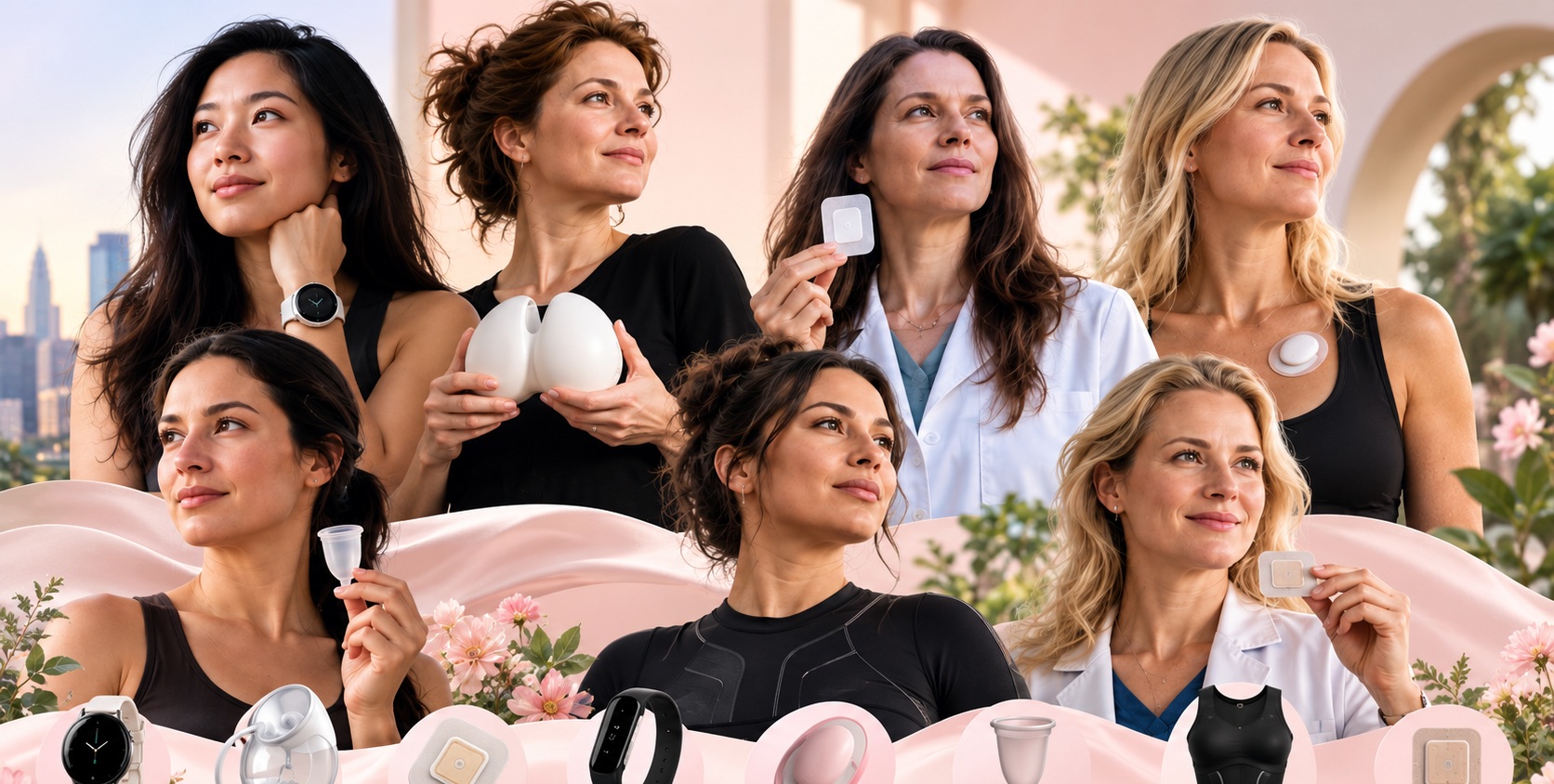
From hormone-sensing wristbands and smart menstrual cups to postpartum blood-loss monitors and culturally inspired waist wearables, these founders are creating technology around women’s bodies rather than adapting women’s bodies to technology originally designed with men in mind.
Their stories are as remarkable as the products they are building.
1. Jenny Duan — The Young Founder Turning Hormones Into Real-Time Data
Jenny Duan is a Stanford graduate and the co-founder of Clair Health, a femtech company developing a wrist-worn device designed to continuously monitor hormone patterns without requiring women to repeatedly provide blood or urine samples.
Duan entered the field after confronting a problem familiar to many women: the difficulty of understanding irregular cycles and hormonal changes with the limited information conventional tracking tools provide. Instead of accepting periodic testing and subjective symptom tracking as the norm, she set out to build a wearable that could continuously listen to the body’s hormonal signals.
Her device contains 10 biosensors and is being developed to infer patterns involving estrogen, progesterone, luteinising hormone (LH) and follicle-stimulating hormone (FSH).
What makes Duan’s story extraordinary is not only the ambition of the technology but the speed at which she has pursued it. At just 21–22 years old, she reportedly raised more than $11.6 million in 2026, with Khosla Ventures leading the round alongside participation from a16z Speedrun and Anne Wojcicki. The funding came in the same period as she graduated from Stanford.
The potential impact is considerable. Continuous hormone data could eventually help women better understand cycle irregularities, energy changes, inflammation, bloating and perimenopause. It could also give doctors a richer picture of hormonal patterns instead of relying solely on occasional tests and patients’ recollections.
With early waitlists exceeding 25,000 people, Duan’s work suggests that women are not merely interested in tracking their health—they want technology capable of actually understanding it.
2. Tania Boler — The Entrepreneur Who Made Women’s Health Wearable
Tania Boler is a women’s health expert, entrepreneur and the founder of Elvie, the company that transformed products for breastfeeding and pelvic-floor health into sophisticated, wearable technology.
Before becoming a femtech entrepreneur, Boler earned a PhD and worked with organisations including the United Nations and Marie Stopes International. Her professional experience exposed her to the health challenges women face, particularly in areas that receive little attention until they become impossible to ignore.
She founded Elvie in 2013 with a simple but powerful premise: products designed for women’s intimate health should not be uncomfortable, embarrassing or technologically inferior.
Her company went on to develop the world’s first silent, wearable breast pump, allowing mothers to express breast milk discreetly while continuing with work and everyday activities. Elvie also developed an app-connected pelvic-floor trainer designed to help women strengthen muscles that can be affected by childbirth and other stages of life.
Boler’s extraordinary achievement is therefore larger than the products themselves. She helped take two subjects that women had traditionally discussed quietly—breast pumping and pelvic-floor health—and put them at the centre of a global technology brand.
Elvie has reached women and mothers across numerous countries, demonstrating how thoughtful design can change not only the function of a healthcare product but also the confidence with which women use it.
3. Anne Andrews — The Scientist Turning Sweat Into a Hormone Monitor
Anne Andrews is a UCLA professor and scientist whose research into the biochemical information contained in sweat has opened another possible route to continuous female hormone monitoring.
Through FemSync, Andrews is helping translate years of scientific research into a wearable patch capable of measuring key female hormones noninvasively over extended periods.
Her story begins in the laboratory rather than the traditional startup world. Andrews spent years investigating how biochemical signals could be measured through sweat, ultimately creating the scientific foundation for a technology that could provide women with hormonal information without requiring repeated blood draws or urine tests.
That transition from fundamental science to wearable health technology is one of her most significant achievements. It demonstrates how research that begins in an academic laboratory can eventually address a very practical problem in women’s everyday healthcare.
The potential applications are wide-ranging. Continuous hormone information could support fertility awareness, contribute to earlier recognition of conditions such as PCOS and provide women and clinicians with clearer evidence of hormonal changes over time.
For women accustomed to explaining their symptoms without much objective data, technology like FemSync could eventually make the invisible measurable.
4. Kelsey Mayo — The Survivor Building a Device to Detect Blood Loss
Kelsey Mayo did not enter medical technology simply because she saw an interesting market opportunity. She became an innovator after surviving a near-fatal internal haemorrhage caused by a ruptured ovarian cyst.
That experience led Mayo to co-found Armor Medical, where she is helping develop a wrist-worn wearable designed to detect early signs of serious blood loss.
The idea is rooted in a deeply personal question: what if dangerous blood loss could be identified before a patient visibly deteriorated?
Armor Medical’s technology is being developed to recognise concerning physiological patterns associated with blood loss and has been designed to work accurately across different skin tones. In 2025, the company won the MedTech Innovator Early Stage Grand Prize, receiving $350,000.
Mayo’s journey from patient to medical innovator is what makes her story particularly compelling. An experience that could have remained a traumatic personal memory became the motivation for developing a technology intended to help other people in similar situations.
The implications are particularly significant for maternal healthcare. Postpartum haemorrhage remains a major cause of maternal mortality worldwide. A wearable capable of detecting deterioration earlier could provide healthcare professionals with precious time to intervene, particularly in settings where continuous clinical monitoring is difficult.
5. Heidi Davis — The Scientist Giving Perimenopause a Data Trail
Heidi Davis is a scientist and the co-founder of IdentifyHer, the company behind Peri, a wearable specifically designed to monitor the symptoms associated with perimenopause.
Rather than designing another general-purpose fitness tracker, Davis focused on a stage of women’s lives that has historically received surprisingly little technological attention.
Peri is a small sensor worn beneath the breast that tracks experiences including hot flashes, night sweats, sleep disruption and anxiety patterns.
Davis’ innovation is important because perimenopause is not a single event. It can involve years of fluctuating hormones and symptoms that affect sleep, concentration, mood, energy and professional life. Yet women are often expected to describe these experiences without objective measurements.
Peri attempts to change that by creating a record of what is happening.
For women, that information could strengthen conversations with healthcare professionals, help identify patterns and provide a clearer way to evaluate whether interventions are making a difference.
Davis is effectively helping turn an often poorly measured life transition into something women can observe, document and better understand.
6. Jenny Button — The Woman Who Turned a Menstrual Cup Into a Health Sensor
Jenny Button is the founder of Emm, and her invention begins with an object millions of women already know: the menstrual cup.
Instead of creating another device that women would have to remember to wear, Button transformed the menstrual cup itself into a source of health data. Emm’s smart menstrual cup incorporates biosensors designed to measure menstrual flow rate, volume and cycle patterns and send the information to an accompanying app.
The concept addresses one of the most basic problems in menstrual healthcare: women are often asked how heavy their periods are, but many have no accurate way of measuring that.
Button’s achievement is turning a familiar period product into a potential continuous monitoring tool.
More accurate information about menstrual flow could help women identify changes that warrant medical attention and support conversations around heavy menstrual bleeding, endometriosis and hormonal disorders.
Her work illustrates an important principle in femtech: sometimes the most transformative innovation does not require women to change their behaviour. It simply makes something they already use significantly smarter.
7. Anna Kormos — The Designer Making Period Pain Wearable
Anna Kormos is a fashion designer and researcher whose own experience with severe menstrual pain inspired her to rethink how women receive pain relief.
She co-founded Artemis, a smart bodysuit designed to deliver heat therapy and micro-vibrations through clothing.
Kormos’ approach is distinctive because she brought fashion and medical technology together. Instead of designing a medical device that women must carry separately, Artemis integrates therapeutic technology into a garment intended for everyday use.
The result is an attempt to make relief more discreet and convenient while avoiding pharmaceutical medication.
Her work addresses a problem that is frequently underestimated. Severe menstrual pain can affect attendance at school, productivity at work, exercise and everyday activities. By creating another option for managing that pain, Kormos is helping challenge the assumption that debilitating periods are simply something women must endure.
Her invention ultimately asks a practical question: what if the clothes a woman wears could also help her feel better?
8. Tosin Oyegoke — The Nigerian Founder Bringing African Body Culture Into Femtech
Tosin Oyegoke is a Nigerian entrepreneur whose journey into wearable technology began not in a laboratory but with one of West Africa’s most recognisable forms of body adornment: the waist bead.
For seven years, Oyegoke designed and shipped traditional waist beads to women in more than 50 countries, building a community of more than 200,000 people. She then transformed that experience into Bèbèdí, a waist-worn wellness wearable designed specifically for women.
Bèbèdí tracks changes in waist circumference alongside indicators including heart rate, temperature, movement, stress and sleep.
What makes Oyegoke’s invention especially distinctive is the cultural thinking behind it. She did not simply create another wearable and ask African women to adapt to it. She started with a familiar cultural form and reimagined it through technology.
That gives Bèbèdí a powerful proposition: modern health technology can emerge from African cultural knowledge rather than simply being imported into African markets.
The company secured provisional patents and developed a multi-thousand-person waitlist ahead of 2026 pre-orders. Its potential applications include monitoring changes associated with hormonal shifts, bloating and broader reproductive wellness.
Oyegoke’s story also expands the geographical narrative of femtech. Some of the most interesting solutions for women’s health are not necessarily coming from Silicon Valley or European laboratories. They can also emerge from African entrepreneurs who understand their communities and build from that knowledge.
9. Kerli Luks — The Doctor Creating a Continuous Hormone Monitor
Kerli Luks is an Estonian doctor and the founder behind Muun Health, where she is developing a microneedle-based wearable patch designed to monitor female hormones continuously and in real time.
Luks’ motivation comes from clinical medicine. As a doctor, she encountered the limitations of intermittent hormone testing and the difficulty of capturing what can be a rapidly changing biological picture.
Her solution is a wearable patch using microneedle technology to continuously collect hormone information, with early applications focused on fertility care.
The significance of her work lies in bringing clinical insight into device development. Rather than simply creating another consumer wellness tracker, Luks is pursuing a technology intended to have relevance both at home and in clinical environments.
Continuous hormone data could eventually make fertility treatment more precise, reduce reliance on repeated testing and enable healthcare professionals to develop more personalised care pathways.
For women navigating conception and hormonal health challenges, that could mean fewer snapshots and a much clearer picture of what their bodies are doing over time.
A New Standard for Women’s Technology
These nine innovators are working across different technologies, countries and stages of women’s health, but they share the same fundamental conviction: women’s bodies should not be an afterthought in technology design.
For generations, healthcare technology has often measured what was easiest to measure while leaving many female-specific experiences poorly quantified. These innovators are challenging that model by turning hormones, menstrual flow, hot flashes, blood loss, pain, sleep and other intimate physiological signals into data.
The significance goes beyond gadgets.
Better data can give women stronger conversations with doctors. It can help researchers understand conditions that have historically been difficult to measure. It can help women recognise patterns in their own bodies and, potentially, seek care earlier.
And perhaps most importantly, these inventions are changing who gets to define the future of health technology.
The next generation of wearables will not simply count steps or calories. Increasingly, they will listen to the body in ways that previous generations of technology could not.
For women around the world, that shift could mean something remarkably powerful: technology that finally sees their bodies as the standard, not the exception.





Comments are closed.