

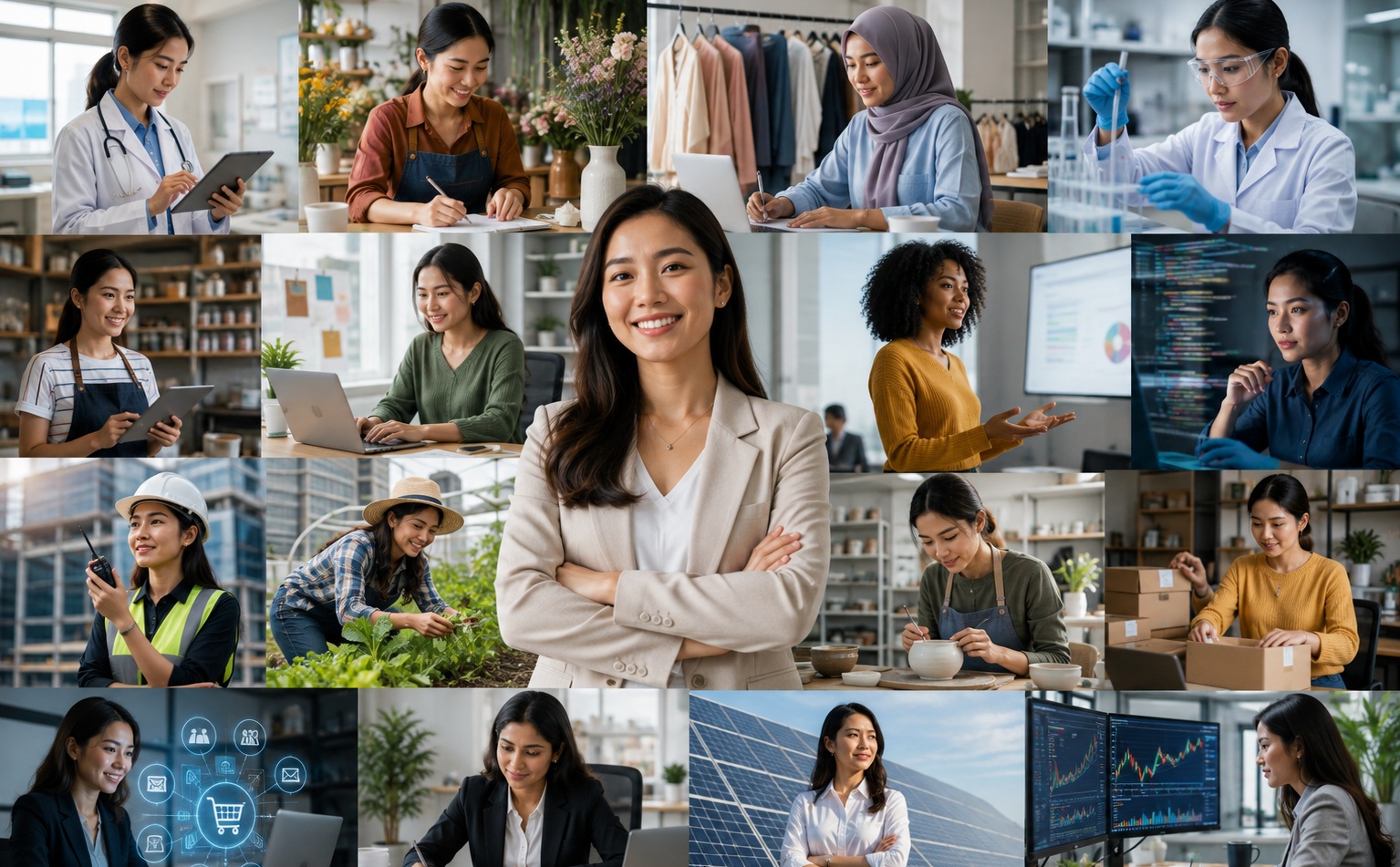
What happens when women stop waiting for opportunities and start building the industries of tomorrow?
Across the world, women entrepreneurs are answering that question through businesses that are transforming healthcare, education, technology, finance, consumer products, construction and sustainability. Their growing presence is not simply about starting more companies; it is about identifying unmet needs, creating new markets and bringing different perspectives into sectors that have traditionally overlooked them. In the United States, women accounted for a significant share of new business formation in recent years, while younger women are increasingly embracing entrepreneurship. At the same time, women continue to receive a disproportionately small share of venture capital, showing that entrepreneurial ambition is rising faster than access to growth capital.
From healthcare and education to artificial intelligence and construction, here are 12 industries where women entrepreneurs are creating new opportunities.
Healthcare, Social Assistance and FemTech
Healthcare and social assistance remain among the strongest areas of women’s business ownership. LendingTree’s analysis of U.S. Census Bureau Annual Business Survey data found that women owned approximately 36.5% of businesses in this sector.
Women entrepreneurs are also creating businesses around women’s health, fertility, maternal care, menopause, mental health, diagnostics and digital health.
The opportunity is significant because women founders often identify problems through lived experience, particularly in areas where traditional healthcare systems have historically underserved women.
Professional, Scientific and Technical Services
Consulting, marketing, design, accounting, coaching and other expertise-driven businesses are another important arena for women entrepreneurs.
Approximately 26% of businesses in professional, scientific and technical services are women-owned, according to LendingTree’s analysis of U.S. Census Bureau data.
Digitalisation is making this sector increasingly accessible. A consultant can serve clients across borders, while artificial intelligence and cloud-based platforms can automate administration, marketing and customer management.
For women with specialised expertise, professional experience can increasingly become a foundation for business ownership.
Education and EdTech
Education is another sector where women entrepreneurs are creating new models.
Approximately 29.4% of U.S. educational-services businesses are women-owned, according to LendingTree’s analysis.
The opportunity extends well beyond traditional schools. Women are building tutoring companies, online learning platforms, professional-development programmes, children’s education services and specialised training businesses.
As employers increasingly demand continuous reskilling, education entrepreneurship is becoming relevant to students, professionals and organisations alike.
Beauty, Skincare and Personal Care
Beauty remains one of the most visible areas of women’s entrepreneurship, but the sector has evolved far beyond traditional salons and cosmetics retail.
Women founders are creating independent skincare, haircare, clean-beauty and personal-care brands, often using direct-to-consumer models and digital communities to build loyal customer bases.
The opportunity increasingly lies in niche positioning, products designed around particular skin types, cultural needs, sustainability preferences or consumer lifestyles.
Wellness, Fitness and Integrative Health
The boundaries between healthcare, beauty and wellness are becoming increasingly fluid.
Women entrepreneurs are building businesses around fitness, nutrition, mental wellbeing, preventative health, coaching and lifestyle services. These businesses respond to consumers who increasingly view health as an ongoing lifestyle rather than something addressed only when illness occurs.
Digital platforms also allow founders to combine physical services with memberships, online communities, courses and personalised programmes.
Retail, E-Commerce and Consumer Products
Women are reshaping retail through direct-to-consumer businesses and online commerce.
Digital platforms allow entrepreneurs to test products, build audiences through social media and reach customers without immediately investing in large physical stores.
This has created opportunities across fashion, lifestyle products, home goods, beauty and culturally specific consumer products.
The model is particularly powerful for women founders who can combine community-building with a strong understanding of their target consumers.
Food, Hospitality and Agri-Food Innovation
Food entrepreneurship continues to provide opportunities through restaurants, catering, specialty foods, beverages and emerging food technologies.
The industry is also evolving around changing consumer priorities, including healthier products, sustainable ingredients, food-waste reduction and alternative proteins.
Women entrepreneurs are increasingly combining food production with e-commerce, subscriptions, events and digital communities, creating revenue streams beyond traditional hospitality models.
Home Services and Construction-Related Trades
One of the most striking developments is taking place in an industry not traditionally associated with women entrepreneurs: home services.
Yelp’s 2025 She-conomy Services Report found that women-owned home-service business openings exceeded 15,000 in 2024, making home services the leading category for women-owned openings on the platform for the second consecutive year.
Growth was particularly notable in traditionally male-dominated trades. Women-owned lawn-service businesses increased by 31%, electricians by 15%, landscaping by 13% and handyperson services by 11%.
This is more than a diversification story. It demonstrates women entering markets where strong consumer demand and labour shortages are creating opportunities.
Fintech and Financial Services
Women entrepreneurs are also building businesses around savings, investing, payments, financial education and financial inclusion.
The opportunity is particularly significant in emerging markets, where digital financial services can reach consumers who have historically been excluded from formal financial systems.
Yet this sector also exposes one of the biggest barriers facing women founders: access to capital. PitchBook data shows that companies founded solely by women continue to receive only a small fraction of venture capital investment.
The opportunity exists, but the financing ecosystem has yet to match the ambition.
Artificial Intelligence and Human-Centred Technology
Artificial intelligence is changing what it takes to start and operate a business.
AI tools can reduce administrative costs, accelerate content creation, support customer service and help small teams perform tasks that previously required larger workforces.
Women entrepreneurs are applying these technologies to healthcare, education, family support, productivity, customer experience and small-business operations.
The opportunity is therefore twofold: women can build AI companies, but they can also use AI to make existing businesses more efficient and scalable.
Sustainability, Cleantech and the Green Economy
The transition towards a lower-carbon economy is creating opportunities across renewable energy, sustainable materials, recycling, green consulting, climate technology and environmentally responsible consumer products.
Women entrepreneurs are increasingly entering this space by combining commercial opportunities with environmental and social objectives.
Sustainability is no longer simply a corporate responsibility issue. It is becoming a market opportunity spanning energy, agriculture, construction, manufacturing, transport and consumer products.
Real Estate, Rental and Property Services
Real estate and related services provide another significant avenue for women entrepreneurs.
LendingTree’s analysis found that approximately 27.8% of U.S. businesses in real estate and rental and leasing are women-owned.
Women are participating through property management, real-estate advisory services, short-term rentals, property technology and specialised property services.
As housing markets evolve and technology changes how properties are marketed and managed, new opportunities are emerging for entrepreneurs who can solve specific customer problems.
From Traditional Strengths to New Frontiers
What connects these 12 industries is not a single definition of women’s entrepreneurship. Instead, the pattern shows women moving in two directions at once.
They continue to build businesses in sectors historically associated with women, healthcare, education, beauty, care and consumer services. At the same time, they are entering areas traditionally dominated by men, including construction, electrical services, plumbing, technology and finance.
That shift matters because entrepreneurship is not only about economic participation. It is also about deciding which problems receive investment, which consumers receive attention and which markets are created next.
The Funding Gap Still Matters
Despite the expansion of women-led businesses, access to capital remains one of the biggest barriers to scale.
Women may be approaching parity in business formation in some markets, but all-female founding teams continue to receive only a small share of global venture capital.
This creates a fundamental contradiction: women are increasingly demonstrating that they can identify opportunities and build businesses, yet the capital ecosystem does not consistently provide the resources required to take those businesses to the next level.
Closing that gap will be essential if today’s entrepreneurial activity is to become tomorrow’s industry leadership.
Conclusion: Women Are Building Beyond the Expected
The rise of women entrepreneurs is no longer confined to a handful of familiar industries.
Women are building healthcare companies, education platforms, beauty brands, fintech businesses, AI ventures, construction firms, food enterprises, property companies and sustainability solutions.
The industries tell an important story. Women are not simply participating in existing markets; they are identifying gaps, developing new solutions and entering spaces where their presence was once unexpected.
The next stage is therefore about scale.
Women founders need access to capital, technology, networks, procurement opportunities and global markets that can help viable businesses move beyond survival and into sustained growth.
Because the future of women’s entrepreneurship will not be defined simply by how many businesses women start.
It will be defined by how many of those businesses become the companies that shape industries, create jobs and redefine what leadership in business looks like.
Call to Action: Invest in the Opportunity
The evidence is clear: women are building across virtually every part of the economy.
Now, investors, governments, financial institutions and business ecosystems must ensure that entrepreneurial ambition is matched by access to opportunity.
Back women founders. Fund their growth. Open the networks. Create the markets.
The next generation of industry-defining companies may already be being built by women today. The question is whether the world will give them the capital and opportunity to scale.





Comments are closed.