
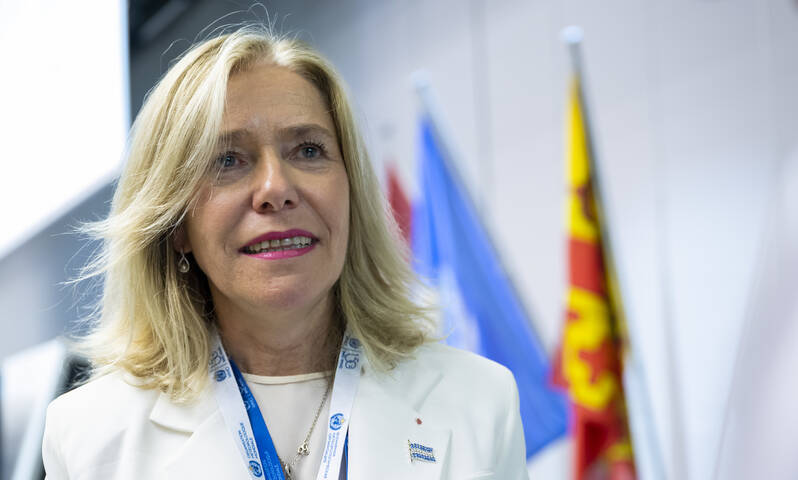
During her address on the occasion of World Meteorological Day 2026, Celeste Saulo, Secretary General of the World Meteorological Organization (WMO) and the first woman to hold this position, delivered a message that captures both urgency and responsibility: “Because when we observe today, we don’t just predict the weather, we protect tomorrow. Tomorrow’s people. Tomorrow’s planet.”
This statement reflects the essence of this year’s theme, “Observing Today, Protecting Tomorrow.” It underscores the critical role of global Earth observation systems, satellites, radars, ocean buoys, and ground stations in shaping accurate forecasts, strengthening climate monitoring, and enabling early warning systems that safeguard lives and livelihoods worldwide.
But beyond the systems and science, it also raises a critical question: who is driving these systems, and who is ensuring they reach those who need them most? Increasingly, the answer includes women.
A World under Pressure and Women Responding at the Frontlines
The urgency of this message is reinforced by the latest findings from the WMO’s State of the Global Climate 2025 report. Global temperatures have reached approximately 1.44°C above pre industrial levels, placing the world dangerously close to the 1.5°C threshold. Climate extremes, floods, droughts, heatwaves, and storms, are becoming more frequent and more severe, affecting economies, food systems, and human security on a global scale.
These developments highlight a critical reality: observation is no longer a scientific luxury. It is a necessity for survival. Early warning systems powered by these observations remain one of the most effective tools for reducing disaster risk and protecting vulnerable populations.
Within this urgency, women are not standing on the sidelines. From research labs to rural communities, they are actively shaping how climate risks are understood, communicated, and managed.
Women at the Heart of Climate and Meteorology
Within this global system, women are playing a transformative and increasingly visible role. Across meteorology, climate science, and early warning systems, women are contributing as researchers, forecasters, engineers, educators, and community leaders. Yet, they remain underrepresented, making up less than 30–40% of professionals in these fields globally.
Despite this gap, their contributions are both significant and far reaching. Women are not only advancing scientific innovation but are also ensuring that climate information is accessible, inclusive, and actionable.
At the highest level, leaders like Celeste Saulo are shaping global climate governance and advocating for gender equality within scientific systems. Her leadership signals more than representation, it signals a shift toward systems that recognize inclusion as a requirement for effectiveness.
From Leadership to Community Impact Women Bridging the Gap
Beyond global institutions, women are driving change at national and community levels. In Africa, for example, Dr. Lucy Mtilatila, Director of Climate Change and Meteorological Services in Malawi, stands as a powerful example of leadership. Her work not only strengthens national climate strategies but also inspires young women to pursue careers in science and meteorology.
At the grassroots level, women serve as essential connectors between scientific data and everyday life. In communities such as Kanyama in Zambia, women volunteers play a critical role in disseminating weather forecasts and early warnings, ensuring that information reaches those most at risk.
This role is not incidental, it is strategic. Women are often trusted communicators within their communities, translating complex data into decisions that protect families, livelihoods, and entire communities.
Their involvement enhances trust, improves response times, and ultimately saves lives.
Innovation, Inclusion, and Better Outcomes: Why Women Matter
Women are also at the forefront of innovation in climate services. From developing AI-enabled tools for localised weather forecasting to supporting climate-smart agriculture for smallholder farmers, women are helping to design solutions that are both practical and inclusive.
Research consistently shows that gender inclusive approaches lead to better outcomes. Countries with higher levels of gender equality tend to demonstrate stronger climate adaptation and environmental performance. Early warning systems that actively include women are more effective in reaching vulnerable populations, while women themselves are significantly more likely to advocate for climate action and accountability.
In other words, women are not just participating in climate systems, they are strengthening them.
The Disproportionate Burden on Women and Why Inclusion Is Urgent
While women are leading change, they are also disproportionately affected by climate impacts. Projections indicate that by 2050, up to 158 million more women and girls could be pushed into extreme poverty due to climate change. Additionally, 80% of people displaced by climate related disasters are women and girls.
This dual reality, of vulnerability and leadership, highlights a critical imbalance. Women are both the most affected and among the most effective responders.
Addressing climate change without addressing gender inequality risks undermining both resilience and sustainability. Inclusion, therefore, is not just a moral imperative, it is a strategic necessity.
Amazons Watch Magazine Perspective: Women as Architects of Climate Solutions
At Amazons Watch Magazine, the perspective is clear: women must be recognised not as passive recipients of climate interventions but as active architects of change.
Through its coverage and advocacy, Amazons Watch Magazine continues to amplify the voices of women shaping climate discourse, from global policymakers to grassroots innovators. It calls for a future where women are not only included but are leading in decision making processes, climate governance, and technological advancement.
This approach reflects a broader truth: climate resilience is strongest where women are empowered to lead.
A Call to Action: Advancing Women in Climate Leadership
Amazons Watch Magazine calls on governments, institutions, and development partners to take decisive action in advancing women’s roles within meteorology and climate science.
There is a need to invest in gender responsive observation systems that ensure climate data reaches and empowers women at all levels. Expanding access to education, technology, and leadership opportunities in STEM fields is critical to closing the gender gap. Additionally, supporting women-led initiatives in early warning systems, climate adaptation, and innovation will strengthen community resilience and drive sustainable development.
Equally important is the responsibility to tell these stories, to highlight the achievements of women in climate science and inspire future generations to follow in their footsteps.
Conclusion
World Meteorological Day 2026 serves as a reminder that the systems we build today will determine how well we are able to protect tomorrow. Observation, data, and technology are essential, but they must be inclusive and accessible to be truly effective.
Women are already playing a central role in shaping climate resilience, leading at global levels, innovating in science and technology, and strengthening communities on the ground. Their contributions are not supplementary, they are foundational.
As the world continues to confront the realities of climate change, the path forward must prioritize both scientific advancement and intentional inclusion. Ensuring that women are fully represented and empowered within climate and meteorological systems is not optional; it is a strategic imperative.
Because when we observe today, we are not only predicting the future, we are shaping it. And increasingly, women are shaping what that future will look like.





Comments are closed.