

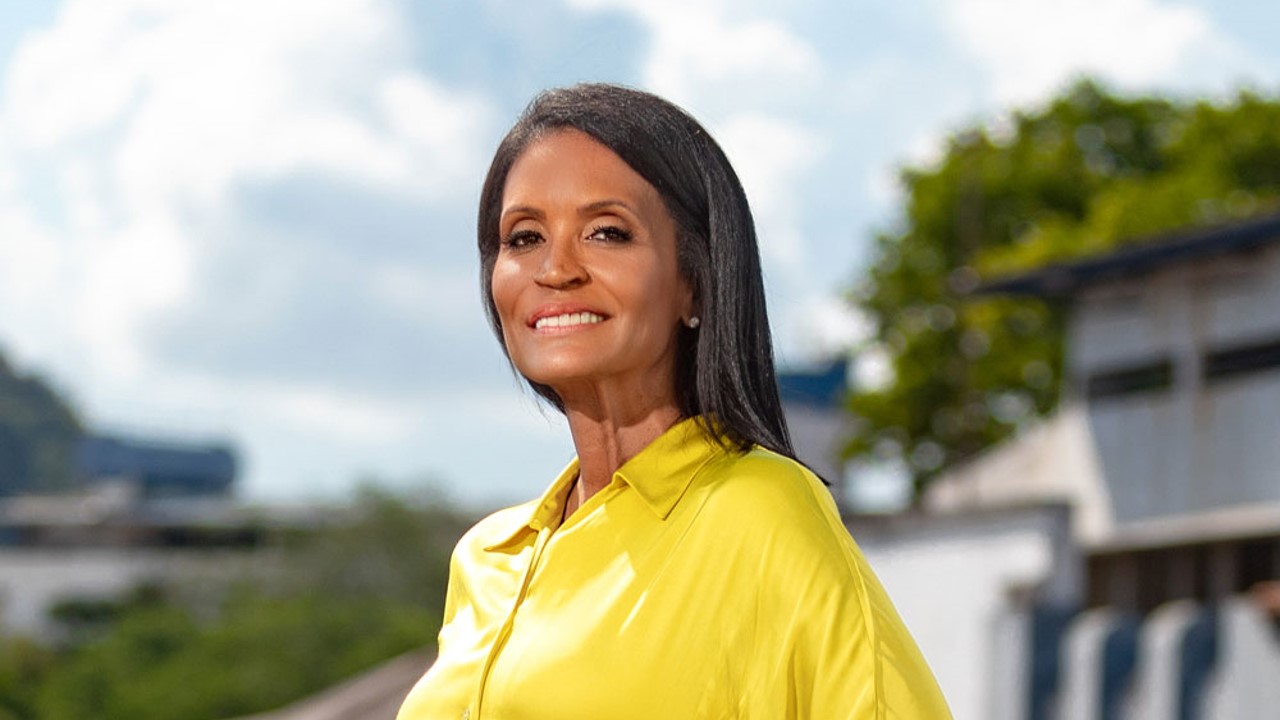
Gloria Karamanites, named Miss Panama, didn’t merely triumph in a beauty contest. She wrote the book.
Gloria Karamanites won the title of Miss Panama in 1980, being the first Black woman to do so.
Pageant organizers staged a last-minute ruse to block her triumph by making her respond to a difficult legal question when she was about to win the crown.
Gloria had to face institutional prejudice, but the Afro-Panamanian community stood behind their “Queen” and supported her attempts to represent their nation.
Forty years later, people still remember where they were when she was crowned because, for the very first time, the country acknowledged that black is beautiful and that Panama is black.
Until the 1980s, beautiful peasants in Panama were populated by wealthy girls. The daughters of high society snoots and upper-crust snobs. Gloria Karamanites was the daughter of someone unknown.
“The night of the peasant was long; we were at a local hotel, getting ready, putting on makeup, and finishing up the final details. I asked the makeup artist to leave me for last, and he asked me why I wasn’t studying my 15 questions, and I told him I am not studying the 15 questions because I always know what they are going to ask.”
In beauty pageants, contestants always get the questions in advance. That’s how it works. That’s how it has always worked. You get the questions; you prepare your answer very simply. Right, when you see that there’s going to be a winner. Right, when it was very clear, “But the night that my mother was competing, something different happened, the pageant officials decided that they would ask a different question. She was unstoppable; she was unbeatable. She won regardless”.
But what gives a serious concern in a country with 60 percent black people? Why would anyone doubt that a black woman couldn’t contest for Miss Panama? The narrative and the world’s representation of Panama see the white as a wrong ruling force. This is a wrong representation of Panama as a country.
Gloria said, “In Panama, we are used to defining beauty according to the standard of the white woman, and we don’t include black and biracial women within our culture and concept of beauty. We don’t include them because we associate beauty with what we constantly see on television.”
Marcos Manjarrez, Gloria’s brother, said, “there were awards that intended for the winner that they never gave her, they thought she wasn’t worthy of the crown ad much less representing Panama because she didn’t correspond to the beauty stereotype of a ‘miss’ “.
In my case, people said I would be like “a cockroach at a chicken dance” that was what was published in the national newspaper that a black Panamanian citizen representing Panama in an international beauty pageant would appear like “a cockroach in a chicken dance” say, Gloria.
The idea that black people don’t belong is myopic because black people are part of the foundation of Panama.
In 1575, the census counted 800 Spaniards living in Panama, as well as 2,809 enslaved Africans and 2,500 maroons or people who escaped enslavement. By the 1920s, white fear of the black uprising and a desire to establish regional support led to a campaign to present a nonblack image of Panama to the world. However, some experts estimate that approximately 60 percent of the country is afro-descendant.
In 2010, the census revealed that less than 10 percent of Panamanians identify as black. 2010 was the first census since the 1920s to ask individuals if they considered themselves black. It was conducted by staff who conversed door to door, and many African Panamanians claimed they weren’t asked the question.
“In a country like Panama, to have someone like Gloria Karamanites not only represents what’s beautiful but also tells the world that in Panama, there are people like me. They are afro-descendant people,” Urenna Best, director of Senadap, says
Adding colour to the reality of our country turns it practically into a battlefield.
“Colon means a whole lot to me because it is where I grew up, where I learned to be myself, where I learned about justice and injustice about black and about how it is being from the colon. There I grew up, cried and played, and many times I was the representative for my province,” said Gloria.
“I got involved in beauty pageants to ease out the things between me and my mother because all my riot situation and stunt throwing could make her lose her job so that’s why I was just balancing the things at home. I had my revolutionary days. I protested against injustice,” said Gloria.
“Colon was a province with many social problems where the government always overlooks the needs of ordinary people like me who are part of the province,” says Gloria.
“Gloria and I organized rallies and protest to fight for the people of the colon. We were fighting for job opportunities for people, better education, for a better health system,” said Porfirio Betegon, historian and activist.
“We wanted the government to be more equitable because we felt that we had been marginalized and that in the distribution of the country’s resources, we had not been properly taken into account”, Gloria says.
Colon is a beautiful, rich province in so many ways, culturally rich. It was a port from the Panamanian canal, but if you walk through the streets of Colon, you will see a lot of poverty. You will see buildings that are falling apart that are not for people to live in, but people are living in them. You will see a city that the rest of the city has abandoned.
“The simple fact that I saw the first black woman win the pageant that was already a revolution,” Gloria says.
“In beauty pageants, I spoke about black women and the ways they are considered second-class citizens. I could speak and express the thing I felt; for some reason, people listened to me,” says Gloria.
“The thing is not only to believe that racism is from someone else to you is also from you to yourself, and that is the most important thing that we need to work in the as the black community is to work on embracing our blackness. To make the youth feel comfortable in their own skin,” Gloria says
“On the night of miss universe, I was glued to my t.v. I called all my friends and family living in Colon that they much watch these” Anadia Clinton, Gloria’s friend.
“I remember there was an uproar, an outburst of joy among everyone, all the Neighbours, everyone was happy. Yes, because they thought Panama wouldn’t place at all. Since it was the first time a black woman was representing Panama in a contest like miss universe,” Marcos said.
Anadia said, “when they called Gloria to the finalist, I screamed my lungs out”.
Although Gloria didn’t win the miss universe, very few contestants from Panama had made it to the top 12 before, but for people in colon who were watching for all the black people in Panama, that was a major victory.
“When they said, “come on down, Miss Panama,” I said, “aha, take that” that’s what I said in my brain because I knew that there were so many people who expected less, who expected me to return empty-handed, so that was my thought”, Gloria said.
“She made history when she came from Seoul, Korea. They didn’t receive her well. They were supposed to take her all around Panama. She did something for us”, said Anadia
Dr Karl Leroi Austin said, “when she returned to Panama, we saw the underlying problems of not giving her the recognition that other girls had received. We had a group that worked in the black community. One of them jumped in and said let’s give her a car. Well, we did it; we had a car with a big black bow to show that it was a gift from the black community.”
In her concluding remarks, she said, “Gloria Karamanites becoming the first black Miss Panama, Yes it was a change in the whole spectrum, and it was history only because another little girl could see and say “ if she was missing Panama, I could be too” or a doctor or a lawyer. And that if she can dream it, she can have it”.




Comments are closed.