
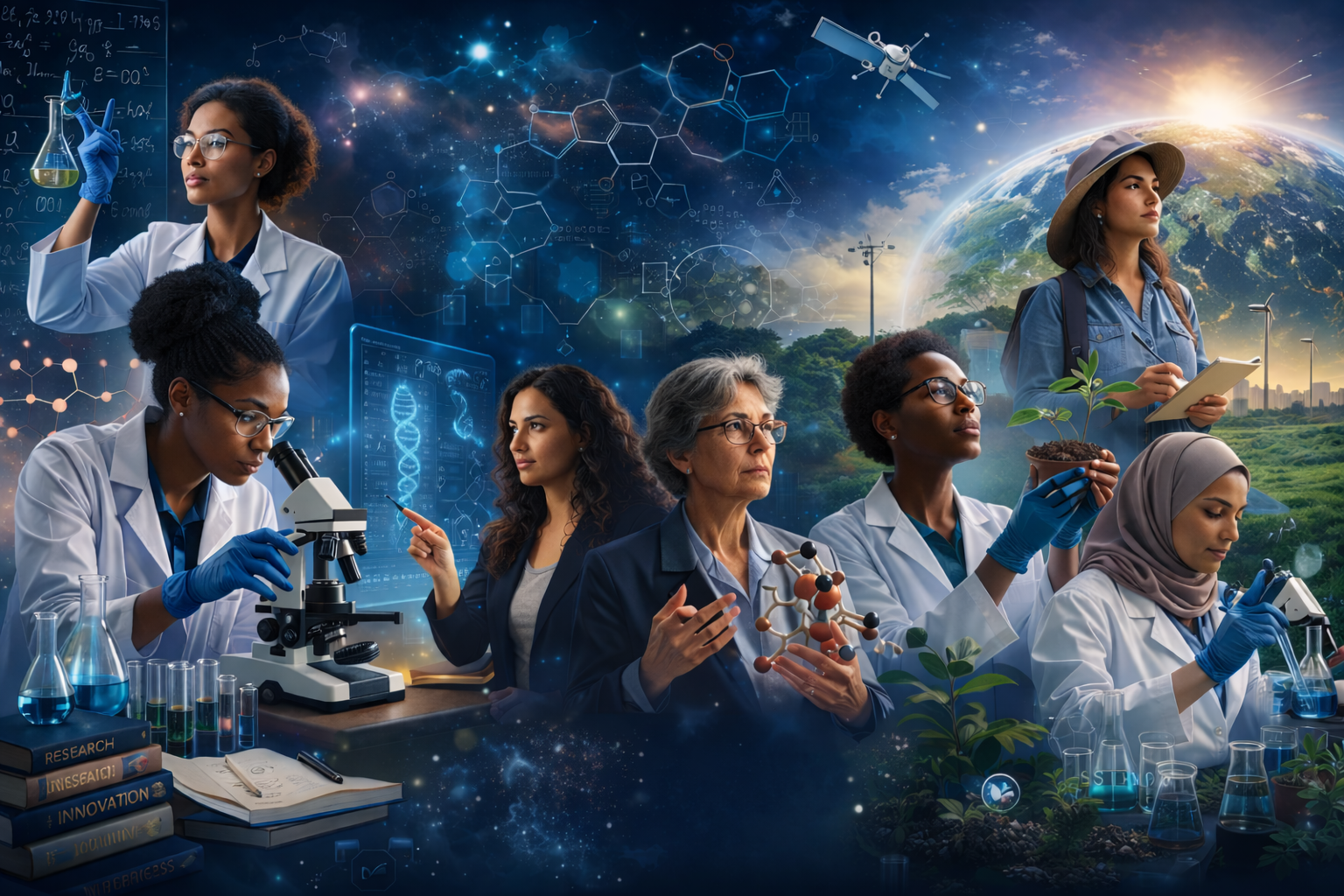
There is something powerful, almost poetic, about a woman in a lab coat, a lecture hall, or deep in the field, quietly shaping the future. Not for applause, not for recognition, but for impact. Across continents and disciplines, women are asking bold questions, challenging long-standing assumptions, and pushing the boundaries of knowledge. Yet even with this brilliance, the global research landscape still reflects a gap that cannot be ignored.
Women make up roughly one third of the world’s researchers, despite representing about half of the global population and an increasing share of university graduates. In many regions, especially in parts of Asia, their presence in research remains significantly lower, while even in areas where participation is higher, leadership roles remain limited. In science, technology, engineering, and mathematics, women continue to face barriers that slow progression into senior academic positions and innovation leadership.
The innovation ecosystem tells an even more complex story. Women are still underrepresented in patent authorship and high impact research recognition, even though evidence shows that diverse research teams often produce more creative and far reaching solutions. This persistent gap is often described as a leaky pipeline, where talented women gradually drop off at different stages of their academic and professional journeys due to structural and cultural challenges.
And yet, despite these realities, women are not waiting to be invited into spaces. They are creating them, leading them, and transforming them. Across the world, a remarkable group of women, our Academic Queens, are redefining excellence in research and innovation.
Quarraisha Abdool Karim, South African Epidemiologist, Global HIV Prevention Leader, and Champion for Women’s Health Equity
Her work in HIV prevention has transformed health outcomes, particularly for women in Africa who remain disproportionately affected by the epidemic. By advancing research on prevention tools such as tenofovir gel, she has helped reduce infection rates, influenced global treatment guidelines, and strengthened the integration of gender responsive healthcare strategies across high burden regions. Beyond the laboratory, she has been instrumental in shaping policy conversations, advocating for women centered interventions, and ensuring that scientific breakthroughs translate into accessible, life saving solutions for communities that need them most.
READ ALSO: Why More Women Must Sit at Decision Tables
Chen Hualan, Chinese Virologist, Influenza Research Authority, and Global Biosecurity Contributor
Through her groundbreaking studies on avian influenza, she has not only developed effective vaccines but also strengthened global surveillance systems for emerging infectious diseases. Her work continues to play a vital role in preventing pandemics and safeguarding both agricultural economies and public health. She stands at the intersection of science and global safety, ensuring that early detection, rapid response, and scientific innovation remain at the forefront of disease control efforts worldwide.
Emmanuelle Charpentier, French Microbiologist, Nobel Laureate, and Co Pioneer of CRISPR Gene Editing Technology
Her contribution to the development of CRISPR technology revolutionised molecular biology and redefined what is possible in genetic engineering. This innovation enables precise DNA editing, opening transformative pathways for treating genetic disorders, advancing regenerative medicine, and accelerating biomedical research worldwide. Her work has not only expanded scientific capability but has also reimagined the future of medicine, offering hope for conditions once considered untreatable.
Andrea Gamarnik, Argentine Molecular Virologist, Infectious Disease Specialist, and Dengue Research Leader
Her research has deepened global understanding of how mosquito borne viruses replicate and spread, particularly in regions heavily affected by dengue outbreaks. Her contributions are central to developing antiviral strategies and strengthening public health responses in vulnerable communities. Through her work, she bridges laboratory science with real world application, ensuring that research outcomes directly inform disease prevention and control strategies.
Heather Zar, South African Pediatric Pulmonologist, Child Health Advocate, and Global Respiratory Disease Research Leader
Her work focuses on childhood respiratory diseases in low resource settings, where access to healthcare is often limited. Through improved diagnostics, prevention strategies, and treatment models, she has significantly reduced mortality rates and improved quality of life for children worldwide. Her commitment extends beyond research, as she continuously advocates for equitable healthcare access and child centered medical innovation.
Caroline Dean, British Plant Scientist, Climate Adaptation Expert, and Agricultural Innovation Researcher
Her studies on how plants respond to environmental and seasonal changes are critical in developing climate resilient crops. In a world facing food insecurity, her research offers practical solutions for sustainable agriculture and global food systems. Her work is particularly significant as climate change continues to challenge traditional farming methods, making her contributions essential to future food stability.
Amy T. Austin, Argentine Ecologist, Environmental Scientist, and Sustainability Thought Leader
Her work explores how ecosystems function and respond to human activities, particularly in changing climates. By advancing knowledge on nutrient cycles and biodiversity, she contributes to global strategies for environmental preservation and ecological balance. Her research emphasizes the delicate interconnectedness of nature and the urgent need for sustainable practices.
Hailan Hu, Chinese Neuroscientist, Mental Health Research Innovator, and Leader in Emotional Brain Studies
Her discoveries in social and emotional neuroscience are helping to decode the biological foundations of depression. Her work is paving the way for new treatment approaches that address one of the most pressing global health challenges. By bringing clarity to complex emotional processes, she is helping to reshape how mental health is understood and treated.
María Ángela Nieto, Spanish Developmental Biologist, Cancer Research Authority, and Cellular Transformation Expert
Her groundbreaking work on embryonic development has provided crucial insights into cancer metastasis. By understanding how cells change and migrate, she is helping to unlock new therapeutic strategies for combating aggressive cancers. Her research stands at the forefront of efforts to reduce cancer mortality through innovative scientific approaches.
Rose Leke, Cameroonian Immunologist, Public Health Advocate, and Mentor for African Scientific Leadership
Her contributions to malaria research, maternal health, and immunisation programs have improved health outcomes across Africa. She is also a dedicated mentor, nurturing the next generation of African scientists and leaders. Her legacy lies not only in her research but in the countless lives she has influenced through mentorship and advocacy.
Geneviève Almouzni, French Epigenetics Research Leader, Chromatin Biology Expert, and Pioneer in DNA Organization Studies
Her research has transformed understanding of how DNA is packaged and regulated within cells. These insights are fundamental to studying development, disease progression, and cancer biology. Her work continues to influence how scientists approach gene expression and cellular identity.
Nada Jabado, Canadian Pediatric Oncologist, Genetic Research Pioneer, and Innovator in Brain Tumor Studies
Her discovery of histone mutations has revolutionised the understanding of pediatric brain cancers. Her work is leading to more accurate diagnoses and more effective, targeted treatments for young patients. She continues to push the boundaries of pediatric oncology with a focus on precision medicine.
These women are not just researchers. They are visionaries, mentors, and architects of change. They remind us that when women lead in science, the outcomes are not only innovative but deeply human centered. Their work touches lives, shapes policies, and builds futures.
But their stories also raise an important question. What more could be achieved if more women were supported to enter, remain, and lead in research and innovation?
The responsibility does not lie with women alone. It belongs to institutions, governments, educators, and communities. It is about creating environments where girls are encouraged to explore science, where women are funded and promoted, and where leadership is defined by merit, not gender.
Let’s Take Action to Advance Women in Research and Innovation
Now is the time to move beyond admiration into action. Invest in girls’ education in science and technology. Create policies that support women in research careers. Fund female led innovation. Celebrate women scientists not just in moments of recognition, but as everyday leaders shaping our world.
Because the future of innovation depends on diversity of thought, and the world cannot afford to silence half of its brilliance.
The Academic Queens are already leading. The question is, how many more will we empower to rise?





Comments are closed.